
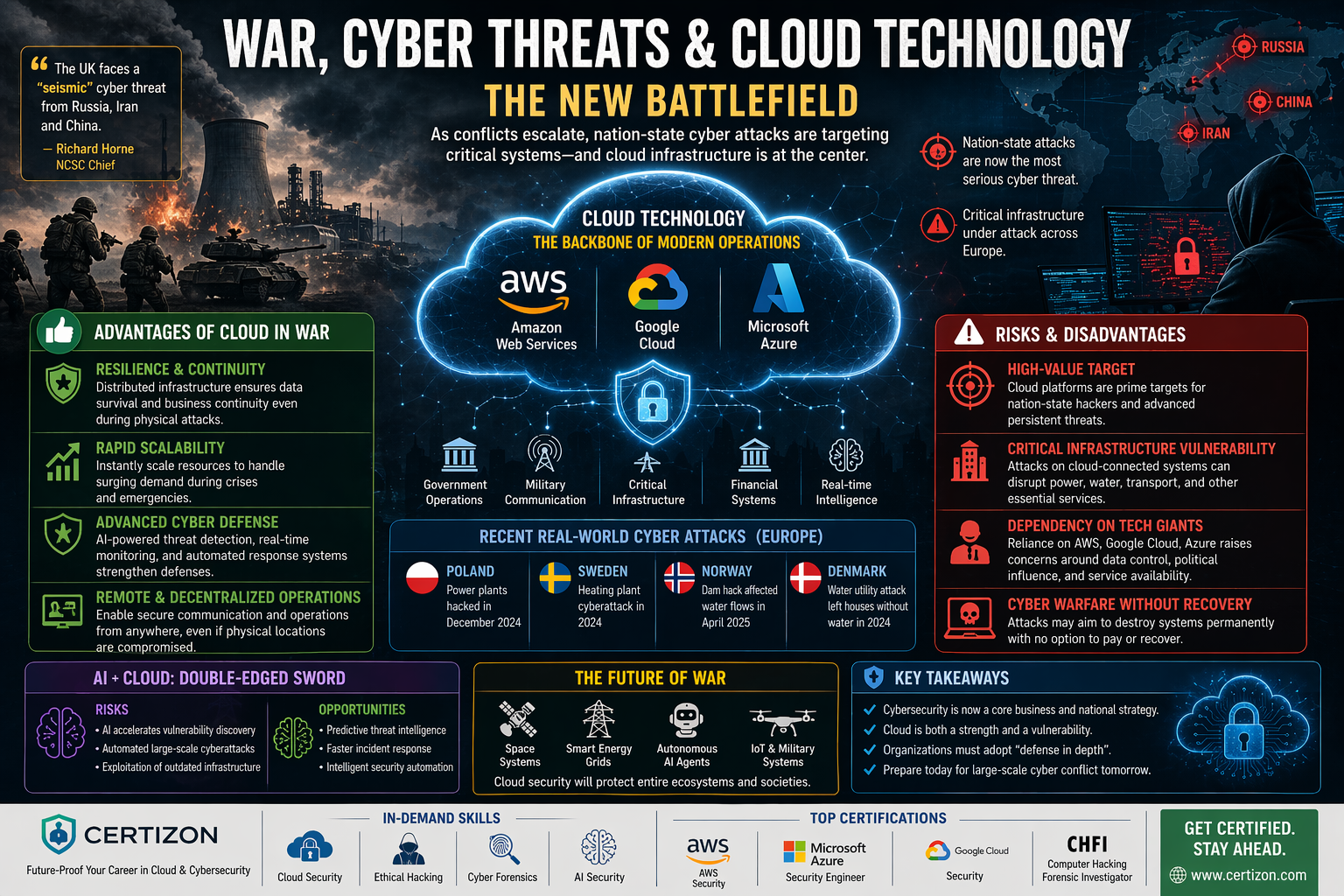
War, Cyber Threats & Cloud Technology: The Backbone of Modern Conflict
The nature of war has changed.
Today, conflicts are no longer confined to physical battlefields. They extend deep into cyberspace—targeting data, infrastructure, and the very systems that keep nations running.
According to Richard Horne, head of the National Cyber Security Centre, the world is experiencing a “seismic geopolitical shift”, where cyberattacks by nation-states like Russia, China, and Iran are now among the most serious threats.
And at the center of this digital battlefield?
☁️ Cloud technologies like Amazon Web Services, Google Cloud, and Microsoft Azure.
☁️ Cloud Technology: The New War Infrastructure
Cloud platforms are no longer just IT tools—they are strategic national assets.
From military communication to power grid management, cloud systems now power:
- Critical infrastructure
- Government operations
- Defense systems
- Financial networks
During conflicts like the Russia-Ukraine War, cloud computing ensured:
- Government data survival despite physical attacks
- Continuity of essential services
- Real-time intelligence sharing
🚀 Advantages of Cloud Technology in Times of War
1. Resilience & Continuity
Cloud infrastructure is globally distributed:
- Data is replicated across regions
- Systems remain operational even if one location is attacked
➡️ This makes cloud a critical survival tool during war
2. Rapid Scalability During Crisis
War brings unpredictable demand spikes:
- Emergency response systems
- Defense analytics
- Public communication platforms
Cloud platforms scale instantly—no physical setup required.
3. Advanced Cyber Defense
Cloud providers deploy:
- AI-driven threat detection
- Real-time monitoring
- Automated incident response
This creates a strong defensive shield against cyber warfare.
4. Remote & Decentralized Operations
Even if physical offices or command centers are compromised:
- Teams can operate remotely
- Governments stay functional
- Military coordination continues
⚠️ The Dark Side: Risks & Disadvantages
1. High-Value Target for Nation-State Attacks
Cloud platforms are prime targets for:
- State-sponsored hackers
- Advanced cyber warfare groups
- Hybrid warfare operations
As highlighted by the NCSC, cyberattacks are now happening at scale, often without warning.
2. Critical Infrastructure Vulnerability
Recent attacks across Europe show alarming trends:
- Power plants in Poland targeted
- Water systems disrupted in Norway and Denmark
- Heating systems attacked in Sweden
➡️ These systems often rely on cloud-connected networks
3. Dependency on Tech Giants
Heavy reliance on cloud providers like:
- Amazon
- Microsoft
…creates concerns around:
- Data control
- Political influence
- Service availability during conflict
4. “Cyber Warfare Without Recovery”
Unlike traditional ransomware:
- Attacks may aim to destroy systems permanently
- No recovery option—even with payment
➡️ This makes resilience more important than prevention alone
🤖 AI + Cloud = A New Cyber Arms Race
Modern cyber warfare is being accelerated by AI.
Advanced systems are capable of:
- Identifying vulnerabilities instantly
- Automating large-scale cyberattacks
- Exploiting outdated infrastructure
At the same time, AI also enables:
- Predictive cybersecurity
- Faster threat mitigation
- Intelligent defense systems
➡️ This creates a double-edged sword scenario
🛰️ The Future of War: Beyond Earth
Cybersecurity is expanding into new domains:
- Space-based communication systems
- Smart energy grids
- Autonomous AI agents
- IoT-enabled military systems
Cloud security will soon protect not just IT systems—but entire ecosystems and societies.
🔐 Key Takeaways for Organizations
- Cybersecurity is now a core business strategy
- Cloud is both a strength and a vulnerability
- Organizations must adopt “defense in depth”
- Preparing for large-scale cyber conflict is essential
🎯 What This Means for Your Career
The demand for skilled professionals in:
- Cloud Security
- Ethical Hacking
- Cyber Forensics
- AI Security
…is rising rapidly.
Certifications in:
- AWS Security
- Azure Security
- Google Cloud Security
- Cyber Forensics (CHFI)
…are becoming essential in this new era of digital warfare.
💡 Final Thought
We are no longer preparing for future cyber wars—
we are already in one.
And in this new reality:
The cloud is not just infrastructure—it is the battlefield.