AI Platform Security at Risk: What the Lovable Data Exposure Incident Teaches Us
As artificial intelligence platforms rapidly gain adoption across industries, they are becoming essential tools for developers, businesses, and enterprises. However, with increased usage comes increased risk.
A recent incident involving Lovable has raised serious concerns about data security and access control in AI platforms, especially when sensitive information is involved.
🚨 What Happened in the Lovable Incident?
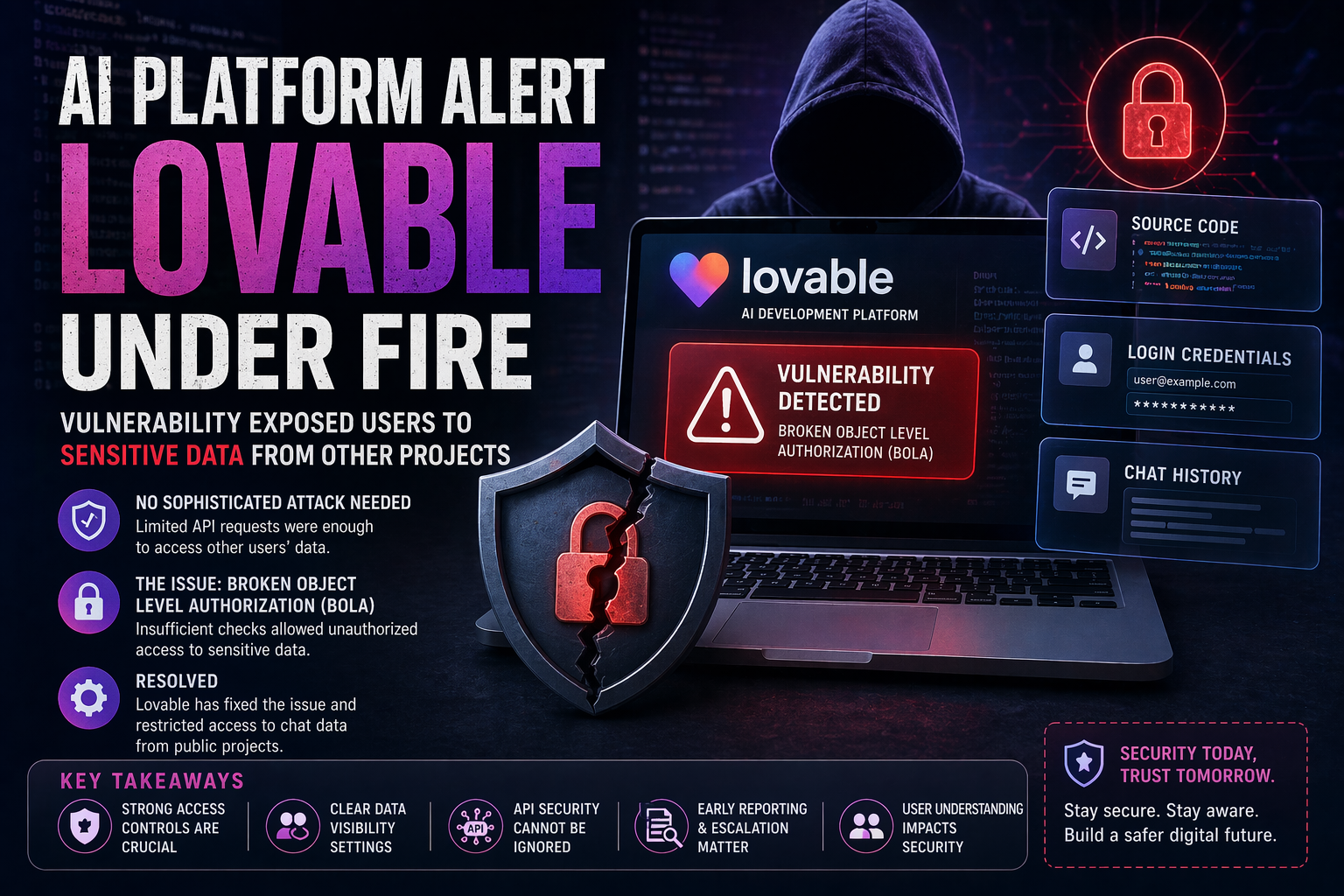
Lovable came under scrutiny after a security researcher revealed a vulnerability that allowed users to access sensitive data from other users’ projects.
According to reports:
- Users could access source code, login credentials, and chat histories
- The issue did not require advanced hacking techniques
- A limited number of API requests was enough to retrieve data
- The vulnerability was linked to a Broken Object Level Authorization (BOLA) issue
This means the platform failed to properly verify whether a user was authorized to access specific data—one of the most common and dangerous API security flaws.
⚠️ Understanding the Core Vulnerability: BOLA
The incident was caused by a flaw known as Broken Object Level Authorization.
What does this mean?
In simple terms, the system did not properly check:
👉 “Should this user be allowed to access this data?”
As a result, users could unintentionally or maliciously access information belonging to others.
This type of vulnerability is especially critical in platforms dealing with:
- User-generated content
- Sensitive business data
- AI-generated interactions
🧩 Where Things Went Wrong
Initially, Lovable stated that there was no data breach, suggesting that the issue was related to how public projects were configured.
However, further clarification revealed:
- Users misunderstood what “public” meant
- Chat data linked to projects could also be exposed
- Documentation lacked clarity on data visibility
- Security assumptions did not align with real-world usage
This highlights a major issue in modern platforms:
👉 Security is not just about design—it’s about how users actually use the system.
⏱️ Delayed Response & Its Impact
The vulnerability had reportedly been submitted earlier through a bug bounty platform but was not escalated because it was initially considered “intended behavior.”
Only after renewed attention did the platform:
- Restrict access to chat data
- Fix the vulnerability
- Improve communication around data privacy
While the issue has now been resolved, the delay raises concerns about how vulnerabilities are evaluated and prioritized.
🌍 Why This Matters for Businesses
AI platforms like Lovable are increasingly used by large organizations, including companies like Uber and Deutsche Telekom.
This means:
- A single vulnerability can impact multiple organizations
- Sensitive enterprise data could be exposed
- Trust in AI platforms can be significantly affected
🔐 Key Security Lessons from This Incident
1. Access Control Is Critical
Every request must be validated properly—no exceptions.
2. “Public” vs “Private” Must Be Crystal Clear
Ambiguity in settings can lead to unintended exposure.
3. API Security Cannot Be Ignored
Modern platforms rely heavily on APIs, making them a prime attack surface.
4. Bug Reports Should Be Taken Seriously
Early detection is useless without proper escalation.
5. User Experience Impacts Security
If users misunderstand settings, security design has failed.
🛡️ How Organizations Can Protect Themselves
To avoid similar risks, businesses should:
- Implement strict access control and authorization checks
- Regularly audit API endpoints and permissions
- Ensure clear data visibility controls for users
- Conduct frequent security testing and penetration testing
- Train teams on secure development practices
🎓 The Growing Need for AI & Cybersecurity Skills
Incidents like this highlight the increasing demand for professionals skilled in:
- API Security
- Cloud Security
- Ethical Hacking
- Incident Response
Certifications such as:
- Certified Ethical Hacker (C|EH)
- Certified Penetration Testing Professional (C|PENT)
- Certified Cloud Security Engineer (C|CSE)
…are becoming essential for securing modern AI-driven platforms.
Conclusion
The Lovable incident is a clear example of how small security gaps can lead to significant data exposure, especially in fast-growing AI ecosystems.
As AI continues to reshape industries, one thing is certain:
👉 Security must evolve alongside innovation
Because in today’s digital world, it’s not just about building powerful platforms—
it’s about building secure and trustworthy ones.