
Website Defacement & Data Theft Claims: What the Seiko USA Incident Reveals About E-Commerce Security Risks
Cyberattacks are evolving beyond silent breaches. Today, attackers are increasingly combining public disruption with extortion tactics to pressure organizations into rapid responses.
A recent incident involving Seiko USA highlights this shift—raising serious concerns about e-commerce security, customer data protection, and incident response readiness.
🚨 What Happened?
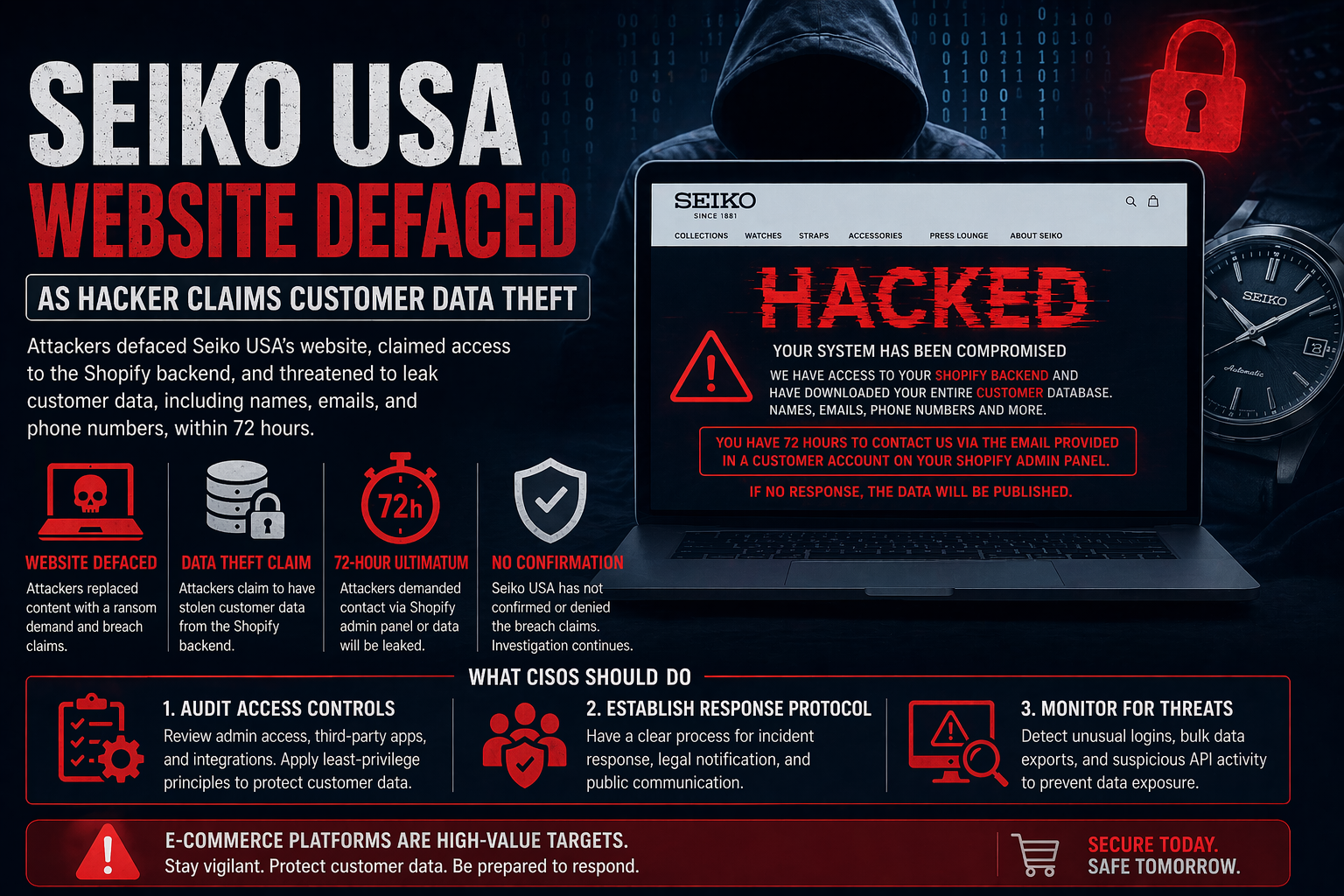
Over the weekend, the website of Seiko USA was defaced by attackers, specifically targeting the “Press Lounge” section.
The attackers replaced content with a page titled “HACKED”, which included:
- A ransom demand
- Claims of a data breach
- Allegations of access to the company’s Shopify backend
According to the message, the attackers had downloaded a customer database containing names, email addresses, and phone numbers.
They issued a 72-hour ultimatum, demanding communication through a specific channel within the Shopify admin panel, threatening to publish the data if ignored.
While the defaced content has since been removed, the company has not officially confirmed or denied the breach, and the authenticity of the claims remains unverified.
👥 Who Could Be Affected?
If the claims are accurate, the incident could impact:
- Customers whose data is stored in the Shopify backend
- Individuals whose personal information (PII) may have been exposed
At this stage:
- The number of affected users is unknown
- No verified dataset has been publicly confirmed
👉 This uncertainty is exactly what makes such attacks effective—they create pressure without immediate clarity.
⚠️ Why This Matters for Security Leaders
This incident is not just about defacement—it’s about psychological pressure in cybersecurity.
Attackers are using a strategy where:
- Public defacement creates urgency and reputational risk
- Data breach claims amplify fear
- A strict deadline forces rushed decisions
Even if the claims are exaggerated or false, organizations must treat them as potentially real threats.
🧠 The Bigger Risk: E-Commerce Backend Exposure
Platforms like Shopify are powerful but also high-value targets.
Why?
- They store customer personally identifiable information (PII)
- They allow admin-level access to orders and data
- They often integrate with third-party apps and APIs
If attackers gain access through:
- Compromised credentials
- Weak authentication
- Third-party integrations
👉 The entire customer database can become an extortion asset.
🔐 Key Lessons from the Seiko USA Incident
1. Website Defacement Is a Signal, Not the End
Defacement is often just the visible layer of a deeper issue.
2. Data Breach Claims Create Immediate Pressure
Even unverified claims can damage trust and force rapid responses.
3. Admin Access Is a Critical Weak Point
A single compromised account can expose massive amounts of data.
4. Third-Party Integrations Increase Risk
Each integration expands the attack surface.
5. Time Pressure Is Part of the Attack Strategy
The 72-hour deadline is designed to disrupt decision-making.
🛡️ 3 Practical Actions for Organizations
🔍 1. Audit Access Controls
Review all accounts, roles, and third-party apps connected to your Shopify or e-commerce backend.
Apply least privilege principles to limit exposure.
⚡ 2. Establish an Incident Response Protocol
Have a predefined plan for:
- Internal investigation
- Legal and compliance notification
- Public communication
👉 Avoid making decisions under pressure.
📊 3. Monitor Data Access Continuously
Implement alerts for:
- Unusual admin logins
- Bulk data exports
- Suspicious API activity
E-commerce platforms should be treated as high-risk environments.
📉 A Pattern of Targeting
It’s worth noting that Seiko has faced cyber incidents before, including a ransomware-related breach in 2023.
This highlights an important reality:
👉 Organizations that are targeted once may be targeted again.
Conclusion
The Seiko USA incident reflects a growing trend in cybercrime—combining technical intrusion with psychological manipulation.
Whether the data theft claim is real or not, the impact is immediate:
- Customer trust is at risk
- Brand reputation is challenged
- Security teams are forced into rapid response mode
In today’s digital landscape, preparedness is the only real defense.
Because modern cyberattacks are not just about stealing data—
👉 They’re about controlling the narrative and forcing action.