
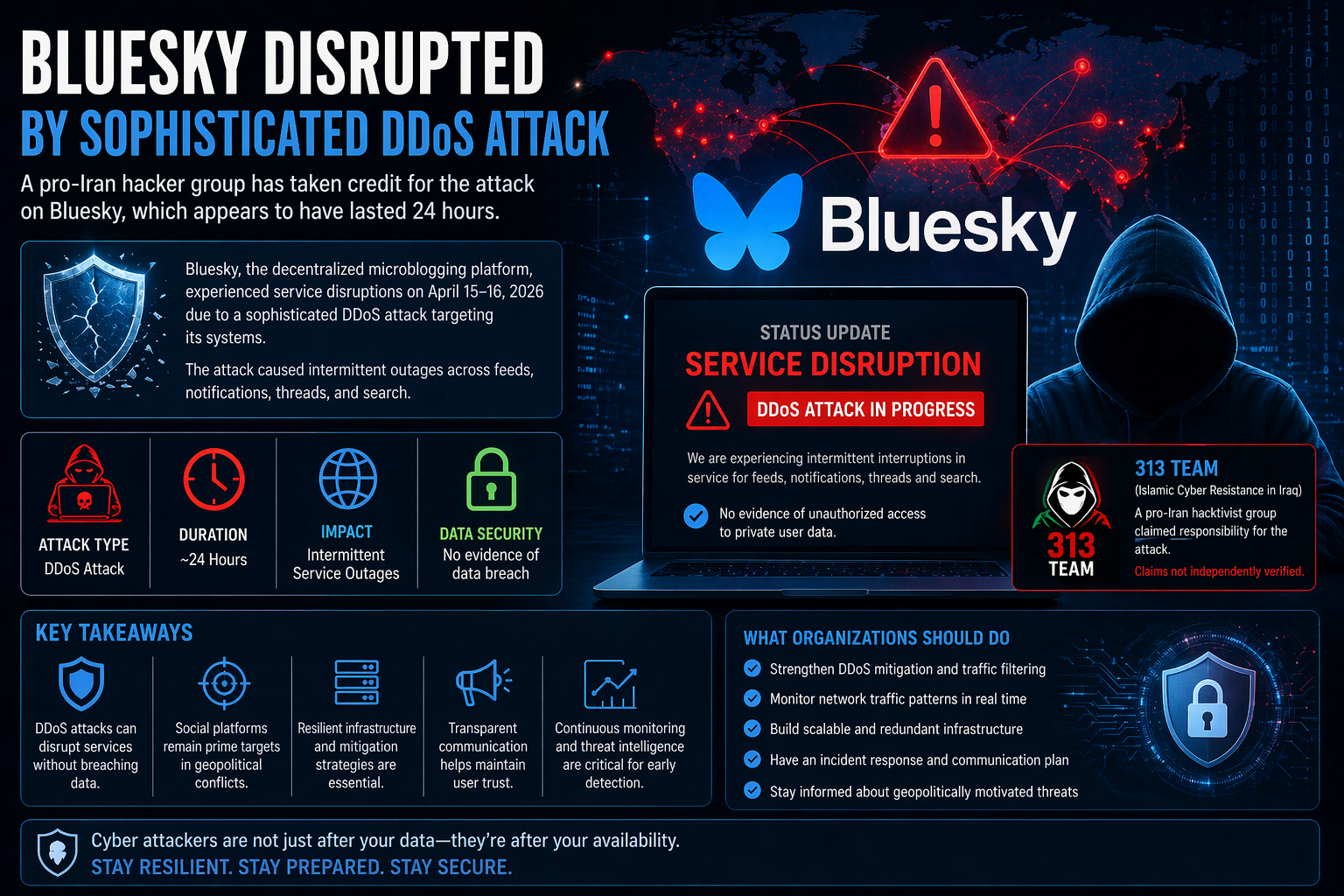
Bluesky Hit by DDoS Attack: What This Means for Social Media Security
Cyberattacks are no longer limited to data breaches—they are increasingly focused on disrupting services and controlling digital platforms.
A recent incident involving Bluesky highlights how even modern, decentralized platforms are vulnerable to large-scale distributed denial-of-service (DDoS) attacks.
🚨 What Happened?
Bluesky experienced service disruptions lasting nearly 24 hours due to a sophisticated DDoS attack.
The attack:
- Began on April 15 (Pacific Time)
- Continued into the following day
- Caused intermittent outages across feeds, notifications, threads, and search
While the platform remained operational in parts, users experienced significant instability and downtime.
🔍 Was User Data Compromised?
According to Bluesky:
👉 There is no evidence of unauthorized access to private user data
This is a crucial distinction—DDoS attacks are typically designed to:
- Overwhelm systems
- Disrupt services
- Damage reputation
…rather than steal data directly.
🕵️ Who Was Behind the Attack?
A group known as 313 Team claimed responsibility for the attack.
The group, also referred to as Islamic Cyber Resistance in Iraq, is believed to have pro-Iran affiliations and has been active during geopolitical tensions involving the United States, Israel, and Iran.
However:
👉 These claims have not been independently verified
It’s important to note that hacktivist groups sometimes:
- Exaggerate their capabilities
- Claim responsibility for visibility
- Act as proxies or personas for larger entities
⚠️ Why This Attack Matters
This incident highlights several critical trends in modern cybersecurity:
1. DDoS Attacks Are Becoming More Sophisticated
Attackers are using advanced techniques to sustain attacks for longer durations.
2. Availability Is a Key Target
Even without data theft, service disruption can:
- Impact user trust
- Affect platform reliability
- Cause financial and reputational damage
3. Social Media Platforms Are High-Value Targets
Platforms like Bluesky are attractive because they:
- Serve large user bases
- Influence public communication
- Are tied to geopolitical narratives
4. Geopolitical Cyber Activity Is Increasing
Cyberattacks are increasingly linked to global conflicts and digital activism.
🛡️ How Bluesky Responded
Despite the scale of the attack, Bluesky was able to:
- Mitigate the DDoS attack
- Maintain partial service availability
- Prevent prolonged outages
This indicates the presence of resilient infrastructure and response mechanisms, which are essential for modern platforms.
🔐 Key Lessons for Organizations
1. Prepare for Availability Attacks
Security is not just about protecting data—it’s about ensuring uptime.
2. Invest in DDoS Mitigation Solutions
Use:
- Traffic filtering
- Rate limiting
- Content delivery networks (CDNs)
3. Monitor Traffic Patterns in Real-Time
Early detection can significantly reduce impact.
4. Build Resilient Infrastructure
Distributed systems can help absorb and manage attack traffic.
5. Have a Crisis Communication Plan
Clear communication during outages helps maintain user trust.
🌍 The Bigger Picture
The Bluesky attack is part of a broader shift in cyber threats:
👉 From data theft → to disruption and influence
Attackers are now targeting:
- Platform availability
- Public perception
- Digital communication channels
🧠 Conclusion
The DDoS attack on Bluesky serves as a reminder that no platform is immune to disruption.
Even without a data breach, the impact of downtime can be significant.
In today’s cyber landscape:
👉 Resilience is just as important as security
Because the real challenge is not just preventing attacks—
👉 it’s ensuring your systems stay online when it matters most.