
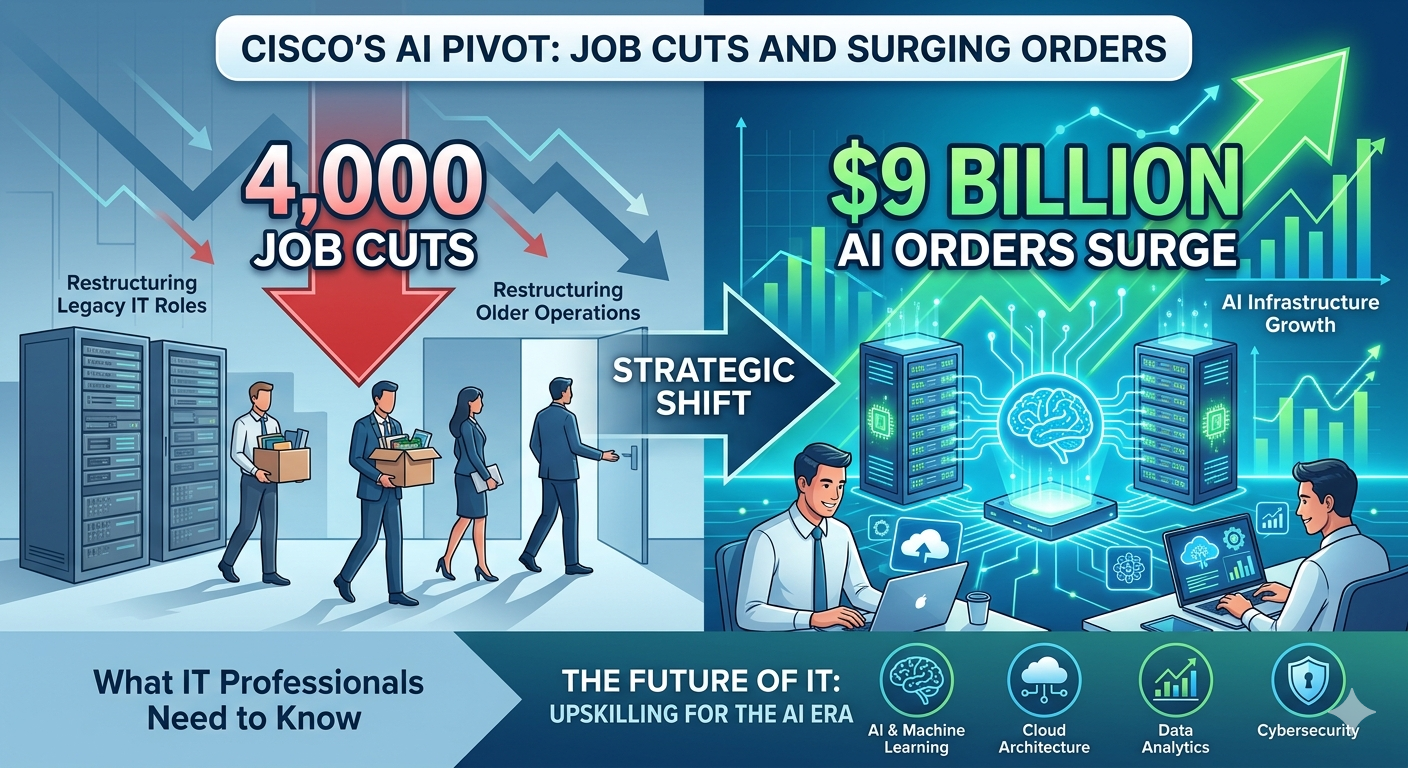
Cisco Cuts 4,000 Jobs as AI Orders Surge to $9 Billion: What Every IT Professional Needs to Know
Cisco's latest earnings report delivered two headlines that appear to contradict each other — but together tell a clear story about where enterprise technology is heading. On one hand, the networking giant announced it would cut nearly 4,000 jobs, representing less than 5% of its global workforce. On the other hand, Cisco raised its full-year revenue forecast, reported a 16% surge in after-hours share price, and revealed that AI infrastructure orders from hyperscalers have already reached $5.3 billion this fiscal year — with a full-year target now raised to $9 billion. For IT professionals, this combination of layoffs and surging AI-driven growth is not a contradiction. It is a roadmap. The skills that are being cut are being replaced by skills that Cisco — and the broader industry — is urgently hiring for. Understanding that shift is the first step to being on the right side of it.
Cisco by the Numbers: The AI Pivot in Data
|
Figure |
What It
Means |
|
$9B |
Full-year AI infrastructure
order target (raised from $5B) |
|
$5.3B |
AI hyperscaler orders taken
so far this fiscal year |
|
50%+ |
Networking product order
growth in Q3 vs prior year |
|
$6B+ |
Expected AI hyperscale
revenue in fiscal 2027 |
|
16% |
Cisco share price jump in
after-hours trading |
|
<4,000 |
Jobs being cut — less than
5% of total workforce |
What Is Driving Cisco's AI
Restructuring?
CEO Chuck Robbins framed the
restructuring in direct terms in a post on Cisco's website:
The companies that will win in the AI era will be those with
focus, urgency, and the discipline to continuously shift investment toward the
areas where demand and long-term value creation are strongest.
This is the language of
strategic reallocation, not decline. Cisco is not cutting jobs because
it is struggling — it is cutting jobs in some areas to fund aggressive
expansion in others. The company has identified four strategic investment areas
that will absorb the capital and talent freed up by the workforce reduction:
•
Silicon — custom chip development for high-speed AI
networking
•
Optics — the fibre and optical interconnect technology
that moves data between AI systems
•
Security — AI-powered threat detection and network
security infrastructure
•
Employee AI enablement — training and tooling so that Cisco's own workforce can use AI
to be more productive across every function
These four areas map almost
perfectly to the skill sets that are in highest demand across the enterprise
technology sector in 2026. The message to IT professionals is unambiguous: if
your expertise is in legacy network administration without AI or automation,
the pressure is real. If your expertise touches AI networking, optical
infrastructure, cybersecurity, or AI-powered operations, demand has never been
stronger.
Hyperscaler Capex Is 'Spilling Downstream' — What That Means
One of the most insightful
observations about Cisco's
results came from Ryan Lee, Senior Vice President of Product and Strategy at
Direxion:
Though much will likely be made about a slight decrease in
headcount, the post-market move we are seeing is truly the result of
hyperscaler capex spilling downstream. This move validates that this capex is
about more than just chips.
This is a crucial insight for
understanding the current AI infrastructure buildout. The first wave of AI
investment — from 2023 to 2025 — was dominated by GPU procurement. Companies
like Nvidia captured the headlines and the investment dollars as hyperscalers
raced to acquire the compute capacity needed to train and run large AI models.
The second wave, which Cisco's numbers clearly reflect,
is about everything that connects those GPUs together. AI at hyperscale
requires:
•
High-speed networking — moving data between thousands
of GPUs fast enough to train models efficiently
•
Data centre switching — routing enormous volumes of
traffic within and between AI compute clusters
•
Optical interconnects — high-bandwidth, low-latency
fibre connections between servers, racks, and data centres
•
Security infrastructure — protecting AI systems and the
sensitive data they process from increasingly sophisticated threats
Cisco's networking product orders
grew more than 50% in the third quarter compared to the prior year. Data-centre
switching orders rose more than 40%. These are not incremental improvements —
they are extraordinary growth rates that reflect a structural shift in how AI
infrastructure is being built. Cisco's
CFO Mark Patterson said it is reasonable to expect at least $6 billion of
revenue on the AI hyperscale side in fiscal 2027 alone.
The Jobs Being Cut vs. The Jobs Being Created
Understanding which roles are
being eliminated and which are being created is essential for IT professionals
assessing their own career positioning. While Cisco has not published a
role-by-role breakdown, the strategic context makes the pattern clear.
Roles Under Pressure
Functions that rely primarily on
manual, repetitive, or legacy-system-dependent work are the most exposed to
AI-driven consolidation. This includes:
•
Traditional network operations roles that have not
incorporated automation or AI-assisted monitoring
•
Legacy sales and support functions for older product
lines that are being phased out or consolidated
•
Administrative and back-office roles that are being
automated through Cisco's
internal AI enablement programme
•
Roles associated with slower-growth product categories
where Cisco is reducing
investment
Roles in High Demand
The areas where Cisco is increasing investment —
silicon, optics, security, and AI — create demand for professionals with highly
specific expertise:
•
AI networking engineers — professionals who can design
and manage high-speed networks for AI compute clusters
•
Optical network specialists — engineers with expertise
in fibre optics, DWDM, and coherent optics technologies
•
Cloud and data-centre security architects —
professionals who can secure AI infrastructure at hyperscale
•
Network automation engineers — those who can programme Cisco infrastructure using
Python, Ansible, and Cisco DevNet
APIs
•
AI solutions architects — professionals who can help
enterprise customers design AI infrastructure using Cisco products
•
AI enablement specialists — internal and consulting
roles helping organisations embed AI into their operations
What This Means for IT Professionals: The Certification Path Forward
Cisco's restructuring is a
signal, not a sentence. For IT professionals who are willing to invest in the
skills that Cisco and the
broader industry are building toward, this moment represents extraordinary
opportunity. The networking, security, and AI infrastructure skills at the
heart of Cisco's growth
strategy are certifiable, learnable, and in global demand. Here is how Certizon's certification tracks align with the
skills the industry is urgently hiring for:
|
Skill Area |
Key
Certifications |
Why It
Matters Now |
|
Networking
& Infrastructure |
CCNA, CCNP, CCIE, Cisco
Certified Specialist |
Cisco's core hardware — AI
networking is driving 50%+ order growth |
|
Cybersecurity |
Cisco CyberOps, CCNP
Security, CompTIA Security+, CEH |
Cisco is investing heavily
in silicon and security as AI growth areas |
|
Cloud
& Data Centre |
AWS, Azure, GCP, Cisco Data
Centre certifications |
AI hyperscaler
infrastructure connects Cisco hardware to cloud platforms |
|
AI &
Machine Learning |
AI Practitioner, ML
Engineer, Generative AI specialist |
Cisco employees are being
retrained in AI use across the business |
|
Network
Automation |
Cisco DevNet,
Python for Network Engineers |
Automation is replacing
manual network roles — key upskilling area |
|
Optical
& Silicon |
Cisco Optical
certifications, hardware specialisations |
Cisco's strategic silicon
and optics investment — high-demand niche |
The CCNA, CCNP, and CCIE Path: Still the Gold Standard
Despite all the AI
transformation language, Cisco's
core value proposition remains its networking hardware and software — routers,
switches, wireless access points, and the software-defined networking platforms
that manage them. The CCNA (Cisco Certified Network Associate), CCNP (Cisco
Certified Network Professional), and CCIE (Cisco Certified Internetwork Expert)
remain the most recognised networking credentials in the world, and they are
directly relevant to the AI infrastructure buildout.
Why? Because the high-speed
networks being built to connect AI compute clusters are Cisco networks. The data-centre
switches seeing 40%+ order growth are Cisco switches. The optical
interconnects Cisco is
investing in are being configured and managed by CCNP and CCIE holders. If you
hold a Cisco certification or
are pursuing one, the AI wave is not a threat to your career — it is a massive
tailwind.
The key is to ensure that your Cisco expertise includes modern
elements: software-defined networking (SD-WAN,
Cisco ACI), network programmability (Python, REST APIs, Cisco DevNet),
and AI-assisted network operations (Cisco AI Network Analytics, ThousandEyes).
Traditional Cisco expertise alone is not sufficient — but Cisco expertise combined with
automation and AI skills is one of the most sought-after combinations in
enterprise IT today.
Cybersecurity: Cisco's
Third Strategic Investment Pillar
Cisco explicitly named security
as one of its four strategic investment areas alongside silicon, optics, and
employee AI enablement. This is consistent with a broader industry trend: as AI
systems handle more sensitive data and automate more critical business
functions, the attack surface for cybercriminals and nation-state actors
expands dramatically.
Cisco's security portfolio —
including Cisco Secure
Firewall, Cisco SecureX, Cisco Umbrella, Cisco Duo, and the broader
security products acquired through its purchase of Splunk — represents one of
the most comprehensive enterprise security stacks available. Professionals
certified in Cisco's security
products and the underlying frameworks they implement are benefiting from both Cisco's growth and the broader
surge in enterprise cybersecurity spending.
For IT professionals considering
their next certification investment, the combination of Cisco networking credentials and
cybersecurity qualifications — CompTIA Security+, Cisco
CyberOps Associate, CCNP Security, or Certified
Ethical Hacker (CEH) — represents one of the strongest and most durable
skill stacks in the industry.
India and the Global Networking Talent Opportunity
Cisco's AI infrastructure growth
is a global phenomenon, and the demand for networking and security talent it
creates is being felt acutely in India and across Asia. India's position as the
world's largest technology talent pool means that Indian IT professionals are
ideally placed to benefit from the surge in demand for Cisco-certified networking
engineers, AI infrastructure specialists, and cybersecurity professionals.
Indian IT services majors — TCS,
Infosys, Wipro, HCL Technologies, and Tech Mahindra — all hold significant Cisco partnerships and manage
large portions of the global networking infrastructure that is now being
upgraded for AI. As hyperscalers expand their data centre footprints in India
(with Google, Microsoft, and Amazon all announcing major
India cloud investments in 2025 and 2026), the domestic demand for Cisco-certified professionals is
growing alongside the global opportunity.
Certizon's
fully online, self-paced certification programmes make it possible for
professionals across India and Asia to earn globally recognised credentials in Cisco networking, cybersecurity,
and AI infrastructure — without relocating or taking extended time away from
work.
Frequently Asked Questions
Q1: Why is Cisco cutting
jobs while its revenue and orders are growing?
Cisco is reallocating resources
from slower-growth areas to high-growth AI infrastructure areas including
silicon, optics, security, and AI enablement. The restructuring eliminates
fewer than 4,000 roles — less than 5% of the workforce — while the company simultaneously
raises its revenue forecast and lifts its AI order target from $5 billion to $9
billion. The cuts fund the investments, not the other way around.
Q2: Which Cisco products
are driving the AI infrastructure surge?
The primary growth drivers are
high-speed networking products for AI data centres (networking product orders
up 50%+ year-on-year), data-centre switching (orders up 40%+), optical
interconnect products, and Cisco's silicon initiatives for AI networking. These
are the infrastructure layers that connect GPU clusters and move AI workloads
across data centres.
Q3: What does 'hyperscaler capex spilling downstream' mean?
Hyperscalers are the world's
largest cloud companies — AWS,
Microsoft Azure, Google Cloud, Meta, and others. Their capital
expenditure (capex) on AI infrastructure is now moving beyond GPU procurement
(the first wave) to the networking, storage, and security infrastructure needed
to make those GPUs work together at scale. Cisco, as the dominant provider
of enterprise and data-centre networking, is a primary beneficiary of this
downstream capex flow.
Q4: What certifications should I pursue if I want to work in AI networking?
The strongest certification path
for AI networking roles starts with CCNA (foundational Cisco networking), progresses to
CCNP (specialisations available in data centre, enterprise, and security), and
can extend to CCIE for expert-level roles. Complement these with Cisco DevNet for network
automation, and AI or ML engineering credentials for AI-specific networking
roles. Certizon offers programmes across
all of these tracks.
Q5: Is it still worth investing in Cisco certifications given the AI
disruption?
Absolutely — and arguably more
so than ever. Cisco's AI
infrastructure orders are growing at record rates, and the company is investing
billions in the networking products that certified professionals configure,
manage, and secure. The key is to pair core Cisco credentials with modern
skills in network automation, AI-assisted operations, and cloud integration,
which is exactly what Certizon's updated
curriculum reflects.
Invest in the Skills That AI Demand Is Creating
Cisco's restructuring is not a
warning sign — it is a direction sign. The $9 billion in AI infrastructure
orders, the 50% surge in networking product demand, and the explicit investment
in silicon, optics, and security all point toward a clear set of skills that
the industry urgently needs. IT professionals who hold recognised credentials
in Cisco networking,
cybersecurity, cloud infrastructure, and network automation are not just safe
from the disruption — they are positioned to lead it.
Certizon's
globally recognised IT certifications give you exactly those credentials. Visit
certizon.com to explore our full
certification catalogue, access free trial courses, and speak with a career
advisor today.
AI is reshaping the
network. Certified professionals are building it.