
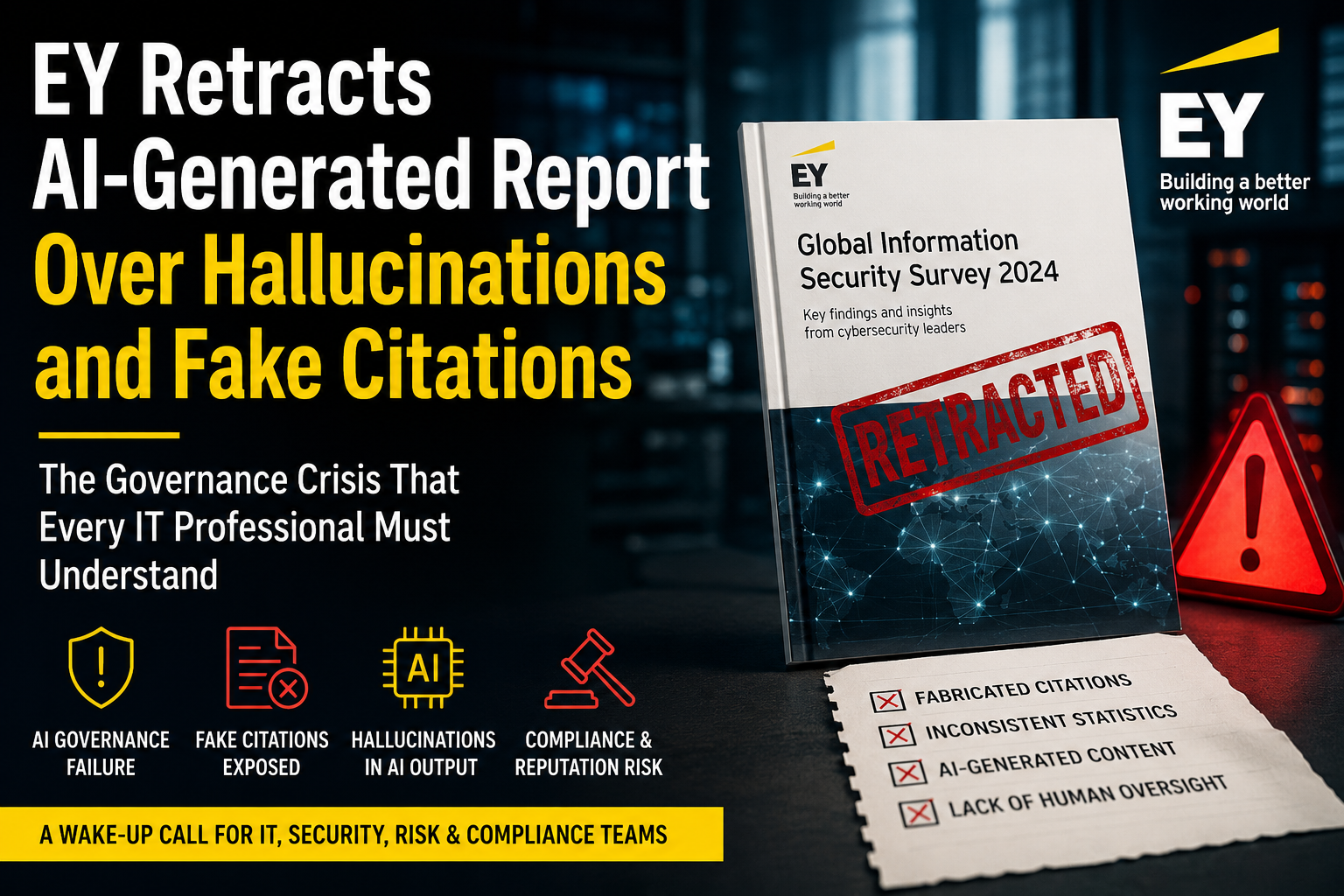
EY Retracts AI-Generated Report Over Hallucinations and Fake Citations: The Governance Crisis That Every IT Professional Must Understand
When one of the world's most respected professional services firms publishes a report containing fabricated data, invented citations, and a reference to a McKinsey study that does not exist — and then has to retract it publicly — the AI industry has a problem that goes far beyond one embarrassing incident. Ernst & Young's retraction of its loyalty rewards programme study in May 2026, after AI detection startup GPTZero flagged it for hallucinations and fake footnotes, is the latest and highest-profile entry in a growing list of AI content failures at major organisations. The EY incident, alongside similar failures at Deloitte and law firm Sullivan & Cromwell, signals an urgent and growing need for a skill that too few organisations have invested in: responsible AI governance, with the certified human expertise to implement it.
What Happened: The EY AI Hallucination Incident
EY Canada's consultants
published a study focused on loyalty rewards programmes, intended to market the
firm's cybersecurity services. The report was publicly accessible on EY's
website — a high-traffic, high-credibility platform associated with one of the
Big Four global accounting firms. On May 14, 2026, researchers Om Ogale, Paul
Esau, and Alex Cui at AI detection startup GPTZero published a blog post
revealing what they had found when they examined the report:
•
Fabricated data points — figures and statistics
presented as research findings that did not originate from any real study
•
Misattributed citations — references attributed to
sources that either did not say what was claimed or were significantly
misrepresented
•
A non-existent McKinsey report — the EY publication
cited a McKinsey study that, when researchers attempted to locate it, simply
did not exist
EY responded by removing the
report from its website and issuing a statement confirming it was reviewing the
circumstances that led to the article's publication. The firm clarified that
the study was not connected to any client project. EY also stated its
organisation-wide commitment to responsible AI use.
Publishing a report online is essentially a form of data
injection into the pool of knowledge that is the internet. When the report
includes fake information — either fabricated citations or false claims — it
can 'poison the well' by misleading future researchers, especially if the
report is published by a well-known consulting firm and hosted on a
high-traffic website. — GPTZero researchers, May 2026
This Is Not an Isolated Incident: A Pattern of AI Content Failures
The EY retraction is the most
prominent recent example of a professional services firm being led astray by
AI-generated content — but it is far from the only one. A pattern is emerging
across multiple industries and firm types:
|
Organisation |
Date |
Context |
AI Failure |
Consequence |
|
EY Canada |
May 2026 |
Loyalty rewards programme report |
Fake footnotes, fabricated data, non-existent McKinsey citation —
detected by GPTZero |
Report retracted from website; internal review launched |
|
Deloitte |
2025 |
Report for Canadian provincial government |
Fake academic citations discovered post-publication |
Report corrected after public scrutiny |
|
Sullivan
& Cromwell |
April 2026 |
US court filing in high-profile bankruptcy case |
Repeatedly misquoted US bankruptcy code; cited incorrect cases |
Law firm apologised to New York court |
Across these incidents, the
pattern is consistent: AI tools were used to generate or assist in producing
professional content; no adequate human verification process was in place; and
the content was published with the credibility of a major organisation attached
to it. The reputational damage, in each case, was disproportionately large
relative to the original error.
Why AI Hallucinations Happen — and Why They Are So Dangerous in
Professional Content
AI hallucination is not a bug
that will be fixed in the next software update. It is a fundamental
characteristic of how current large language models (LLMs) work. LLMs are
trained to generate text that is statistically plausible — text that sounds
like the kind of thing that would appear in a document of a given type. They
are not databases. They do not look things up. They do not verify. They
generate.
This means that when an LLM is
asked to write a research report with citations, it will produce text that
looks like a research report with citations — including, when it does not have
reliable data to draw on, invented data that sounds plausible, and citations to
sources that sound real but may not exist. The model does not know it is doing
this. It has no concept of truth or falsehood, only of plausibility.
In casual use — drafting an
email, summarising a meeting, generating ideas — hallucinations are an
inconvenience. In professional content published under a firm's brand, they are
a serious risk with four distinct dimensions:
1. Reputational Risk
A Big Four accounting firm's
brand is built on decades of trust, rigour, and accuracy. A single retracted
report containing fake citations undermines that trust in a way that takes
years to rebuild. For EY, the incident is particularly damaging because the
report was published to market the firm's expertise — the very competence being
marketed was publicly called into question.
2. Knowledge Contamination Risk
GPTZero's researchers
articulated this risk precisely: publishing AI-generated misinformation on a
high-traffic, high-credibility website poisons the well of knowledge on the
internet. Other researchers, journalists, and organisations may cite the fake information
before the retraction — and those citations persist even after the original
source is removed. AI models trained on internet data may incorporate the
hallucinated information, perpetuating errors across future AI outputs.
3. Legal and Regulatory Risk
The Sullivan & Cromwell
incident demonstrates that AI hallucinations in legal and regulatory contexts
carry direct legal consequences. Misquoting a statute or citing a non-existent
case in a court filing is not merely embarrassing — it is a serious professional
violation that can result in sanctions, client harm, and disciplinary
proceedings. As AI tools are adopted across legal, financial, and regulatory
functions, this risk grows proportionally.
4. Client and Commercial Risk
EY's retracted report was not
connected to a client project — but the next such incident at a consulting firm
may be. An AI-generated client deliverable containing fabricated data could
expose a professional services firm to negligence claims, contract disputes,
and regulatory scrutiny. The commercial consequences could far exceed the
reputational damage of a retracted marketing report.
The Governance Gap: What EY's Incident Reveals About Enterprise AI Adoption
EY's own disclosures make the
governance failure particularly stark. In October 2025, EY announced that its
AI-related revenue had grown 30% in the prior year and that 15,000 staff had
worked on client projects involving AI — including, specifically, AI governance
frameworks designed to help clients implement AI responsibly. The firm that
published a report with hallucinated citations was simultaneously selling AI
governance expertise to its clients.
This is not hypocrisy so much as
it is a reflection of how fast AI adoption has outpaced AI governance maturity
across the professional services sector. Organisations are deploying AI tools
at scale, training staff to use them, and publishing AI-assisted content —
without always having the verification frameworks, human review processes, and
quality assurance protocols needed to catch hallucinations before they go
public.
The core governance gap has
three components:
•
No mandatory human verification step — AI-generated
content is being published without a structured human review process that
specifically checks citations, data points, and factual claims against primary
sources
•
No AI literacy in the review chain — even when human
reviewers are present, they may lack the knowledge of how LLMs work to
recognise that a plausible-sounding citation might be fabricated
•
No clear accountability — without a named human
responsible for verifying AI-generated content before publication,
accountability diffuses and errors slip through
What Certified IT Professionals Can Do About It
The EY incident is not an
argument against using AI in professional services — it is an argument for
using it responsibly, with the right expertise in place. Every one of the
failures in the EY, Deloitte, and Sullivan & Cromwell incidents could have been
prevented by professionals with the right combination of AI literacy,
governance knowledge, and quality assurance discipline. Here are the
certifications that matter most:
|
Certification
Track |
Key
Certifications |
Why It
Addresses the EY Problem |
|
AI Ethics
& Responsible AI |
Certizon AI Governance,
Google Responsible AI, IBM AI Ethics |
Teaches how to implement
human review, auditability, and accountability frameworks before publishing
AI-generated content |
|
AI Prompt
Engineering |
Certizon Prompt Engineering,
OpenAI Prompt Design |
Equips professionals to
write prompts that reduce hallucination risk and include instructions to cite
only verifiable sources |
|
Information
& Data Literacy |
Certizon Data Literacy,
CompTIA Data+ |
Builds the critical thinking
skills needed to verify AI outputs against primary sources before publication |
|
Cybersecurity
& Content Integrity |
CompTIA Security+, Certified
Ethical Hacker (CEH), CISM |
Relevant to EY's original
context — cybersecurity professionals need rigorous standards for AI-assisted
research and reporting |
|
AI Product
Management |
Certizon AI Product
Management, IIBA Business Analysis |
Gives managers the tools to
build AI content workflows with mandatory human review checkpoints before
publication |
|
Generative
AI for Business |
Certizon Generative AI,
Microsoft AI-900, AWS AI Practitioner |
Provides foundational
understanding of how LLMs work, why hallucinations occur, and how to deploy
AI tools responsibly |
|
Project
& Quality Management |
PMP, PRINCE2, Six Sigma
Green Belt |
Structured quality review
and sign-off processes directly address the governance gap that led to EY's
publication failure |
Building a Responsible AI Content Workflow: A Practical Framework
For IT professionals,
consultants, and knowledge workers who use AI tools to produce professional
content, the EY incident is a reminder that AI output requires a structured
verification process before publication. Here is a practical framework —
informed by the governance principles covered in Certizon's AI Ethics and
Responsible AI certification programmes:
Step 1 — Prompt with Integrity
Design prompts that explicitly
instruct the AI to cite only sources it can verify, to flag uncertainty rather
than fabricate, and to indicate when it does not have reliable data.
Well-designed prompts reduce hallucination risk at the source.
Step 2 — Verify Every Factual Claim
Every data point, statistic, and
factual assertion in AI-generated content should be individually verified
against a primary source before publication. This is not optional — it is the
minimum standard for professional content. If a citation cannot be verified, it
should be removed.
Step 3 — Check Every Citation
Every cited source should be
located, accessed, and confirmed to say what the AI claims it says. AI models
frequently misattribute quotes, misrepresent study findings, and cite documents
that do not exist. Citation checking is non-negotiable.
Step 4 — Apply AI Detection Tools
Tools like GPTZero,
Originality.ai, and similar AI detection platforms can help identify content
that is likely AI-generated and flag patterns associated with hallucination.
These tools are not infallible, but they add a useful layer of scrutiny —
ironically, GPTZero's researchers themselves identified the EY report's
failures.
Step 5 — Human Sign-Off with Named Accountability
Before any AI-assisted content
is published under an organisation's brand, a named individual with the
authority and expertise to verify its accuracy should formally sign off on it.
This creates accountability and incentivises the thoroughness that automated
processes alone cannot guarantee.
Step 6 — Document the AI Workflow
Organisations should maintain
records of which AI tools were used to produce which content, with what
prompts, and who reviewed the output. This documentation supports internal
accountability and, increasingly, external regulatory compliance as AI governance
frameworks mature globally.
The Wider Implication: AI Governance Is Now a Core IT Competency
The EY incident, taken alongside
Deloitte's 2025 correction and Sullivan & Cromwell's court apology, points
toward an industry-wide inflection point. AI tools are now deeply embedded in
professional knowledge work. The question is no longer whether to use them — it
is whether organisations have the governance maturity to use them safely.
For IT professionals, this
creates a specific and growing opportunity. AI governance — the discipline of
designing, implementing, and auditing the processes that ensure AI is used
responsibly, accurately, and accountably — is rapidly becoming a core enterprise
IT competency. Organisations that experienced AI failures like EY's are
actively seeking professionals who can help them build the review frameworks,
training programmes, and quality assurance processes that prevent such
incidents.
The professionals best placed to
lead this work are those who combine technical AI literacy — understanding how
LLMs work, why they hallucinate, and how to design prompts that reduce risk —
with governance and quality management skills. Certizon's certification
programmes in Responsible AI, AI Ethics, AI Product Management, and Generative
AI for Business are designed precisely for this growing professional need.
EY Canada takes the accuracy of all the content we publish
seriously, and we have an organisation-wide commitment to the responsible use
of AI. — EY statement, May 2026
That commitment is now the
minimum expectation for every organisation deploying AI. The professionals who
can help organisations live up to it are among the most valuable in the
industry.
Frequently Asked Questions
Q1: What exactly did EY publish that led to the retraction?
EY Canada's consultants
published a study on loyalty rewards programmes intended to market the firm's
cybersecurity services. Researchers at GPTZero found the report contained
fabricated data points, misattributed citations, and a reference to a McKinsey
report that does not exist. EY removed the report from its website and
confirmed it was reviewing how the publication occurred.
Q2: What is an AI hallucination and why does it happen?
An AI hallucination occurs when
a large language model generates text that sounds plausible and authoritative
but is factually incorrect — including invented statistics, fabricated
citations, and references to non-existent sources. Hallucinations happen because
LLMs are trained to produce statistically plausible text, not to verify factual
accuracy. They generate what a document of a given type typically looks like,
which can include realistic-sounding but entirely fictitious data.
Q3: Is EY the only organisation to have this problem?
No. Deloitte was required to
correct a report for a Canadian provincial government in 2025 after fake
academic citations were discovered. Law firm Sullivan & Cromwell apologised
to a New York court in April 2026 after a filing repeatedly misquoted the US
bankruptcy code and cited cases incorrectly. The pattern suggests a systemic
governance gap across professional services AI adoption.
Q4: What certifications help professionals prevent AI hallucination
incidents?
The most relevant certifications
include AI Ethics and Responsible AI Governance programmes, Prompt Engineering
credentials, Data Literacy and Information Verification qualifications,
Generative AI for Business certifications (which cover hallucination awareness),
AI Product Management, and quality management credentials such as PMP or Six
Sigma. Certizon offers programmes across all of these areas.
Q5: How can organisations build processes to prevent AI hallucination in
published content?
Key steps include: designing
prompts that instruct AI to flag uncertainty rather than fabricate; verifying
every factual claim and citation against primary sources before publication;
using AI detection tools to identify potentially hallucinated content;
establishing named human accountability for AI-assisted publications; and
documenting AI workflows for internal governance and regulatory compliance.
Get Certified in Responsible AI — Before Your Organisation Needs a
Retraction
The EY incident is a warning
that organisations across every sector need to take seriously. AI tools are
powerful, productivity-enhancing, and increasingly embedded in professional
knowledge work. But without the right governance frameworks, human review
processes, and certified expertise to implement them, the risk of AI-generated
errors reaching the public — under a trusted brand — is real and growing.
Certizon's certification
programmes in AI Ethics, Responsible AI Governance, Prompt Engineering, and
Generative AI for Business equip IT professionals and knowledge workers with
the skills to deploy AI responsibly — building the verification habits, governance
frameworks, and quality assurance processes that prevent incidents like EY's
before they happen.
Visit certizon.com to explore our full certification catalogue,
access free trial courses, and speak with a career advisor today.
AI generates the draft.
Certified professionals make it trustworthy.
Published by Certizon Editorial Team |
certizon.com | May 18, 2026
SEO | GEO | AEO Optimized Content |
Global IT Certifications