
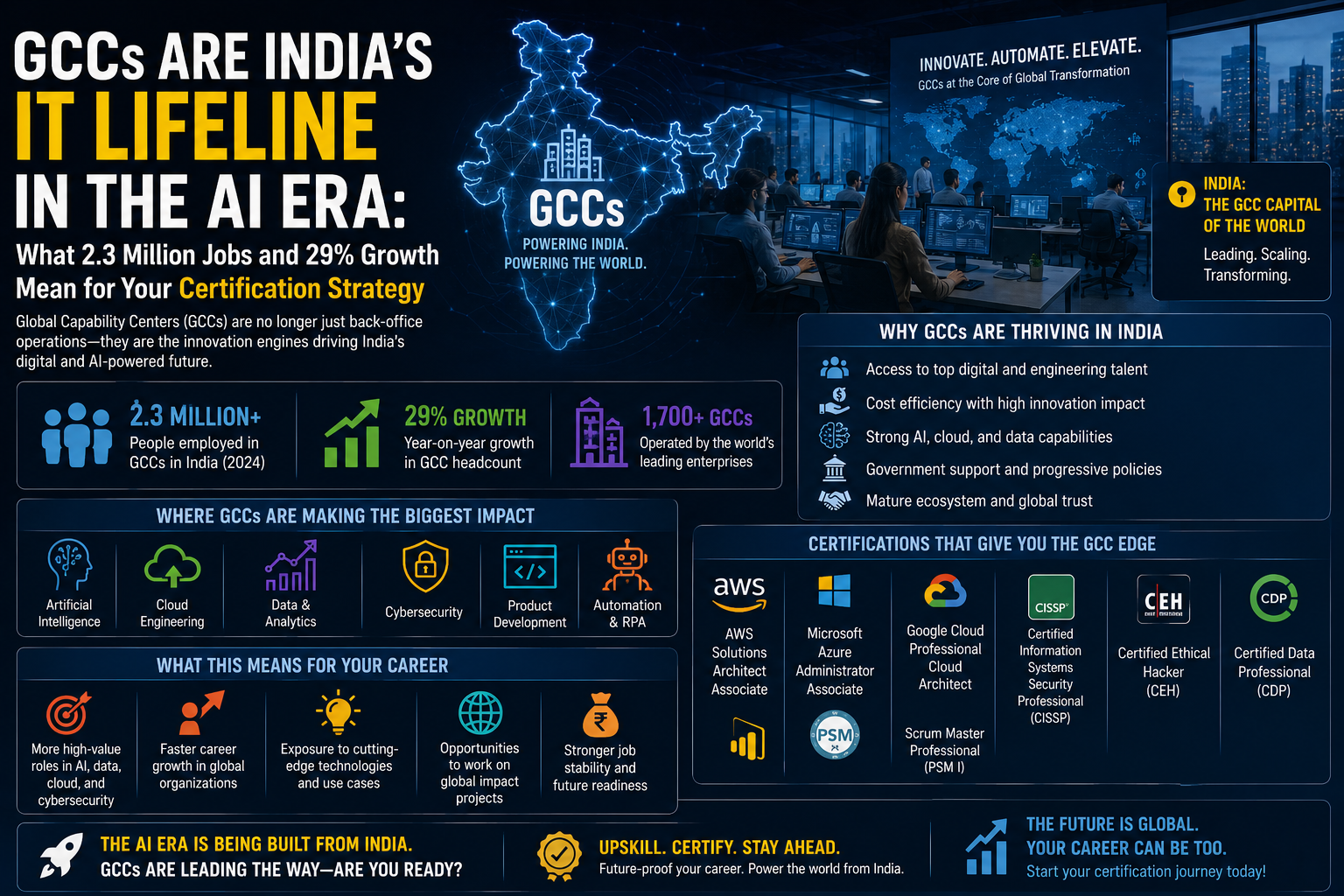
GCCs Are India's IT Lifeline in the AI Era: What 2.3 Million Jobs and 29% Growth Mean for Your Certification Strategy
India's IT sector is experiencing a tale of two realities. On one side, the traditional IT services giants — TCS, Infosys, Wipro, HCL Technologies — are navigating genuine AI headwinds. Roles are becoming more precarious, hiring has slowed, and open positions in the IT services sector fell by 17% in May 2026 compared to the same period last year. On the other side, Global Capability Centres — GCCs — are booming. Demand for GCC roles grew 29% year-on-year and 20% month-on-month in May 2026 alone. India now hosts over 2,100 GCCs employing more than 2.3 million professionals and generating nearly $100 billion in annual revenue. For IT professionals wondering where the opportunities are in an AI-transformed job market, the data has a clear answer: the GCC sector is where India's technology growth story is being written — and certified professionals with the right skill sets are the ones being hired to write it.
The GCC Story in Numbers
|
Figure |
What It
Means |
|
2,100+ |
GCCs currently operating in
India |
|
2.3M+ |
Professionals employed by
GCCs in India |
|
$100B |
Annual revenue generated by
India's GCC sector |
|
29% |
Year-on-year GCC job demand
growth in May 2026 |
|
20% |
Month-on-month GCC job
demand growth in May 2026 |
|
-17% |
IT services sector open
roles — falling in same period |
|
20-25% |
Expected GCC headcount
growth over next two years (Careernet) |
|
90-95% |
Share of Hitachi IQ
development work done in Bengaluru |
What Is a GCC and Why Does It Matter?
A Global Capability Centre is a
company's own offshore strategic unit — not a vendor, not a third-party
partner, but the company itself, operating in India. Unlike the traditional IT
outsourcing model — where an Indian IT firm like TCS or Infosys provides
technology services to a foreign client — a GCC is the foreign company's own
team, its own infrastructure, and its own operations, physically located in
India to access talent and cost advantages.
Abhishek Agarwal, President at
Judge India & Global Delivery, The Judge Group, explains the scope clearly:
A Global Capability Centre is essentially a company's own
offshore strategic unit. GCCs handle everything from technology development,
data analytics, and finance operations to legal, HR, and, increasingly, core
product innovation.
The range of companies that have
established GCCs in India reflects the breadth of this model. From technology
giants like Amazon, Microsoft, Dell, and SAP to financial services firms like
Bank of America and telecommunications companies like Verizon — organisations
across every sector are building their India-based capability centres. Texas
Instruments established the first wholly owned R&D centre in India in
Bengaluru in 1985. Forty years later, virtually every major multinational has
followed.
Girija Kolagada, Country Manager
at Progress Software, identifies the three pillars of India's GCC dominance:
India's rise as the world's preferred GCC destination is built
on three things hard to replicate anywhere else — a vast pool of deeply skilled
technology talent, a culture of engineering excellence, and an ecosystem that
has matured rapidly over the past decade.
Traditional IT Services vs GCCs: A Structural Comparison
Understanding the difference
between traditional IT services and GCCs is essential for IT professionals
making career decisions in 2026. The two models are fundamentally different in
how they are structured, how AI affects them, and what skills they demand:
|
Factor |
Traditional IT Services |
Global Capability Centres (GCCs) |
|
Business
Model |
Third-party outsourcing (client pays vendor) |
First-party in-house operations (no middleman) |
|
AI Impact |
Negative — AI reduces need for large outsourced teams |
Positive — AI expands mandate; more complex work sent to GCC |
|
Hiring
Trend (May 2026) |
Open roles fell 17% year-on-year |
Demand grew 29% year-on-year; 20% month-on-month |
|
Talent
Profile |
Broad hiring; volume-driven staffing model |
Niche, specialised talent in AI, data science, cybersecurity |
|
Skill Focus |
Software development, QA, support, maintenance |
AI engineering, product innovation, cloud infrastructure,
analytics |
|
Growth
Trajectory |
Headwinds — AI automation reducing billable hours |
Accelerating — AI creating more high-value work to send to India |
|
Examples |
TCS, Infosys, Wipro, HCL Technologies |
Amazon, Microsoft, Dell, SAP, Bank of America, Verizon GCCs |
|
Cities |
Bengaluru, Hyderabad, Pune, Chennai, NCR |
Expanding to Tier 2 and Tier 3 cities as model matures |
The Xpheno Tech Outlook report
data makes the divergence stark: while open roles within the IT services sector
fell 17% in May 2026, GCC demand grew 29% year-on-year and 20% month-on-month.
These are not marginal differences — they represent a structural shift in where
India's technology employment is being created.
Why AI Is Helping GCCs Rather Than Hurting Them
The relationship between AI and
GCCs is the inverse of AI's relationship with traditional IT services — and
understanding why reveals something important about where sustainable
technology careers are being built.
For traditional IT services
firms, AI reduces the need for large outsourced teams. If a client's IT
workload can be partially handled by AI tools, the number of billable hours —
and therefore the size of the vendor relationship — shrinks. This is the headwind
that TCS, Infosys, and their peers are navigating.
For GCCs, AI is doing the
opposite. Abhishek Agarwal of The Judge Group explains:
AI, rather than threatening GCCs, is actually expanding their
mandate. Companies are sending more complex, higher-value AI-related work to
their India GCCs precisely because the talent is there, and the centres have
earned trust over years of consistent delivery.
The logic is straightforward: AI
tools reduce the need for large teams doing routine, predictable work. But AI
also creates enormous amounts of new, complex work — designing AI systems,
training models, evaluating outputs, governing AI deployments, integrating AI
into products, and ensuring AI quality. This higher-value work requires skilled
human professionals to guide it. And the most cost-effective pool of those
professionals, globally, is in India.
Neelabh Shukla, Chief Business
Officer at Careernet, identifies the talent profile shift this creates:
Where traditional IT services firms have long relied on bulk
hiring, GCCs are built around niche, specialised talent in AI engineering, data
science, cybersecurity, cloud infrastructure, and product development.
Madhu Murty Ronanki, co-founder
of QualiZeal, adds the quality dimension:
As enterprises scale AI adoption, the focus will shift toward
trusted, governed, and quality-assured AI systems — where specialised Quality
Engineering capabilities will play a critical role.
Bengaluru, Hyderabad, Pune — and Beyond
India's GCC geography is
expanding. Historically concentrated in Bengaluru (which hosts the largest GCC
cluster), Hyderabad, Pune, Chennai, and the National Capital Region, the GCC
model is now moving into India's Tier 2 and Tier 3 cities as the model matures
and talent costs in primary cities rise.
Hemant Tiwari, MD India and
SAARC at Hitachi Vantara, illustrates the depth of India's role in global
technology development:
For Hitachi IQ almost 90 per cent to 95 per cent of development
work happens in Bengaluru. Indian talent is critical for a global company like
Hitachi to be able to develop these kinds of technologies and then deploy them
globally as part of our solutions.
Rohan Lobo, Deloitte partner
covering the GCC sector, sees the geographic expansion as a significant
opportunity for professionals across India, not just those in established tech
hubs:
Growth will not be limited to Bengaluru, Hyderabad, Pune or NCR.
As the model matures, Tier 2 and Tier 3 cities will also become part of the GCC
growth story.
For IT professionals in cities
like Coimbatore, Jaipur, Indore, Kochi, Nagpur, Chandigarh, and Ahmedabad, the
GCC expansion into Tier 2 and Tier 3 markets represents a genuine opportunity
to access high-quality GCC employment without relocating to the country's most
expensive cities.
The Skills GCCs Are Hiring For — and the Certifications That Prove You Have
Them
The GCC sector's hiring surge is
concentrated in a specific set of skill areas that reflect the higher-value,
AI-era work that companies are centralising in their India operations. The
professionals who are capturing GCC opportunities are those who hold globally
recognised certifications in the domains that GCCs prioritise. Here is the full
picture:
|
Skill Area |
Key
Certifications |
Why GCCs Are
Hiring for It |
|
AI &
Machine Learning Engineering |
AI Practitioner, ML
Engineer, TensorFlow Developer, Google Cloud AI |
GCCs are explicitly hiring
for AI engineering talent — the most in-demand skill profile across every GCC
sector in 2026 |
|
Cloud
Architecture |
AWS Solutions Architect,
Azure Administrator, GCP Professional Cloud Architect |
Cloud infrastructure
underpins every GCC operation. AWS, Azure, and GCP certifications are among
the most consistently in-demand across all GCC job postings |
|
Data
Science & Analytics |
Microsoft DP-203, Google
Data Engineer, IBM Data Science, Databricks |
Data analytics is listed as
a core function by every GCC definition. Certified data professionals are
hired in volume by GCCs across every sector |
|
Cybersecurity |
CompTIA Security+, CEH,
CISSP, CISM, CySA+ |
GCCs handle sensitive global
enterprise data — cybersecurity expertise is a non-negotiable requirement for
GCC operations at scale |
|
Product
& Agile Management |
PMP, SAFe Agilist, Scrum
Master, PRINCE2 |
GCCs are moving from
execution to core product innovation. Product management and agile delivery
certifications are growing in demand as GCCs take on higher-value work |
|
DevOps
& Platform Engineering |
AWS DevOps Engineer, Azure
DevOps, Kubernetes (CKA), Docker |
GCCs build and maintain the
engineering platforms that power global enterprise operations. DevOps and
platform certifications are foundational for GCC engineering roles |
|
Quality
Engineering & Testing |
ISTQB, Certizon Quality
Engineering, Selenium, TOSCA |
As Madhu Murty Ronanki
(QualiZeal) noted, quality-assured AI systems will be critical as GCCs scale
AI adoption — QA certifications are growing in relevance |
|
Generative
AI & LLM Engineering |
Certizon Generative AI, AWS
Generative AI, Azure AI Engineer (AI-102) |
GCCs are receiving more
complex, higher-value AI-related work from parent companies. GenAI expertise
is the fastest-growing credential demand in the GCC sector |
Why Certifications Matter More in GCC Hiring Than in Traditional IT
Services
In the traditional IT services
model, hiring was often volume-driven — large cohorts of engineering graduates
hired through campus recruitment, trained internally, and deployed on client
projects. Certifications were useful but not always decisive.
In the GCC model, hiring is
fundamentally different. GCCs are building specialist teams — smaller, more
senior, with niche expertise in defined domains. They are competing for talent
against other GCCs, against Indian IT services firms, and against global remote
hiring. In this context, globally recognised certifications serve a critical
function: they provide objective, internationally comparable evidence of
specific technical capabilities.
A GCC hiring manager at a US
financial services firm's India centre does not have the institutional
knowledge of Indian university rankings and syllabi that an Indian recruiter
might. But they do recognise an AWS Certified Solutions Architect credential, a
Google Professional Data Engineer badge, or a CISSP certification. These
credentials communicate competence in a language that is universally understood
across the global organisations that run GCCs.
For IT professionals targeting
GCC roles — whether they are freshers entering the workforce or experienced
professionals transitioning from traditional IT services — certified expertise
is the most reliable signal of readiness for the niche, specialised work that
GCCs are built around.
The Transition Opportunity: Moving from IT Services to GCC Roles
For experienced IT professionals
currently working in traditional IT services — in companies like TCS, Infosys,
Wipro, or HCL — the GCC surge creates a specific and urgent career transition
opportunity. The work experience gained in IT services is genuinely valuable.
The delivery discipline, project management exposure, and cross-industry client
experience that IT services builds are assets that GCCs actively seek. What IT
services professionals often need to add is the certified depth in specialist
domains — AI engineering, cloud architecture, data science, cybersecurity —
that GCC roles demand.
The transition path typically
involves:
•
Identifying the GCC sector of interest — technology,
financial services, manufacturing, healthcare, or retail GCCs each have
distinct technical stacks and skill requirements
•
Auditing current skills against GCC job postings —
reviewing active GCC openings on LinkedIn, Naukri, and company career portals
to identify the certification gaps between current credentials and target roles
•
Prioritising one or two high-impact certifications —
focusing on the credentials that appear most frequently in target GCC job
descriptions and earning them through an accelerated, self-paced programme
•
Building a portfolio of applied work — GCCs value
demonstrated capability alongside credentials; personal projects, open-source
contributions, and side projects showcase practical skills
•
Networking within GCC communities — Bengaluru,
Hyderabad, and Pune have active GCC professional communities where networking
with current GCC employees accelerates the transition
Frequently Asked Questions
Q1: What is a Global Capability Centre (GCC) and how is it different from
traditional IT outsourcing?
A GCC is a company's own
offshore strategic unit in India — not a third-party vendor but the company
itself operating in India. Traditional IT outsourcing (TCS, Infosys model)
involves a client paying an Indian firm to provide technology services. A GCC is
the client company's own team, physically located in India, handling the
company's own work with no intermediary. Examples include Amazon's India GCC,
Microsoft's India R&D centre, and Bank of America's Hyderabad operations.
Q2: Why are GCC jobs growing while traditional IT services jobs are
declining?
Traditional IT services firms
are affected by AI because AI reduces the need for large outsourced teams doing
routine work. GCCs are benefiting from AI because companies are centralising
more complex, higher-value AI-related work in their India centres. The Xpheno
data shows open roles in IT services fell 17% in May 2026, while GCC demand
grew 29% year-on-year — reflecting this structural divergence.
Q3: Which cities in India offer the most GCC opportunities?
Bengaluru, Hyderabad, Pune,
Chennai, and the National Capital Region (Delhi-NCR-Noida-Gurugram) are
currently the primary GCC hubs. However, Tier 2 cities including Coimbatore,
Jaipur, Indore, Kochi, Chandigarh, Nagpur, and Ahmedabad are seeing increasing
GCC presence as the model matures and primary city talent costs rise.
Q4: What skills and certifications do GCCs hire for most actively?
The most in-demand GCC skill
areas are AI and machine learning engineering, cloud architecture (AWS, Azure,
GCP), data science and analytics, cybersecurity, DevOps and platform
engineering, generative AI, quality engineering, and product management. Globally
recognised certifications in each of these areas — AWS, Azure, GCP credentials,
CISSP, CEH, PMP, ISTQB, and Certizon's specialist AI programmes — are the
credentials GCC hiring managers look for.
Q5: Can experienced IT services professionals transition to GCC roles?
Yes — and this is one of the
most significant career opportunities currently available. IT services
professionals bring valuable delivery discipline, project experience, and
cross-industry exposure. Adding certified specialist skills in AI engineering,
cloud architecture, data science, or cybersecurity to that foundation is
typically what bridges the gap to GCC roles. Certizon's self-paced online
programmes are designed to support exactly this kind of upskilling without
requiring time away from current employment.
Q6: How does Certizon help IT professionals target GCC opportunities?
Certizon offers globally
recognised IT certification programmes in all the skill areas that GCCs
actively hire for — AI engineering, cloud architecture, cybersecurity, data
science, generative AI, DevOps, quality engineering, and product management.
All programmes are fully online, self-paced, and designed to be completed in
four to twelve weeks, with expert-designed curriculum, practice assessments,
and career mentoring.
Your GCC Career Starts With the Right Certification
India's GCC sector is the most
significant technology employment opportunity in the country right now — and it
is growing. With demand up 29% year-on-year, 2.3 million professionals already
employed, and expansion into Tier 2 and Tier 3 cities under way, GCCs are
creating the IT career opportunities that AI is taking away from traditional IT
services. The professionals who will capture these opportunities are those who
hold globally recognised certifications in the specialist skill areas that GCCs
are built to deliver.
Whether you are a fresh graduate
targeting your first technology role, an IT services professional looking to
transition, or an experienced specialist ready for the next challenge,
Certizon's certification programmes give you the credentials that GCC hiring
managers across India's most respected technology employers recognise and
value.
Visit certizon.com to explore our full certification catalogue,
access free trial courses, and speak with a career advisor today.
Traditional IT is navigating headwinds. GCCs are hiring. Certified professionals are the ones they want.