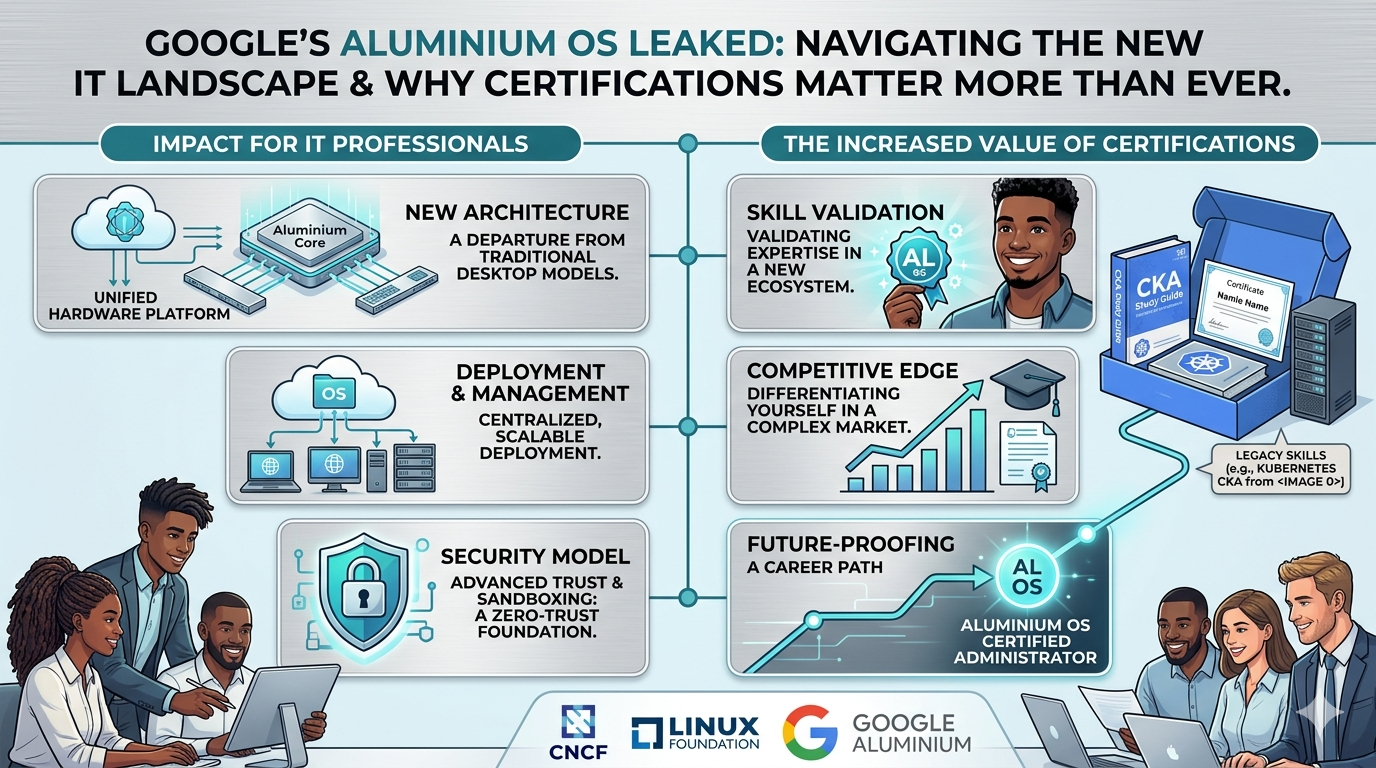
Google's Aluminium OS Leaked: What a New Desktop Platform Means for IT Professionals and Why Certifications Matter More Than Ever
Before Google could take the
stage at The Android Show: I/O Edition 2026, a comprehensive leak gave the
world its first real look at Aluminium OS — Google's long-anticipated desktop
operating system built on top of Android. A 16-minute hands-on video, screenshots,
and detailed feature notes shared by leaker Mystic Leaks reveal an operating
system that is ambitious in vision, familiar in execution, and — critically for
IT professionals — a signal that the enterprise desktop landscape is about to
get significantly more complex and significantly more interesting. For anyone
working in IT support, enterprise device management, cloud infrastructure,
Android development, or cybersecurity, Aluminium OS is not a consumer
curiosity. It is a professional inflection point.
What Is Google's Aluminium OS? The Leak Explained
Aluminium OS is Google's attempt
to bring Android to the desktop — not as a phone-mirroring experience, but as a
genuine, laptop-class operating system. The leaked build was running on a
MacBook Pro through the UTM emulator, giving viewers a surprisingly clear
picture of what Google has been building behind closed doors.
The leaker describes Aluminium
OS as 'essentially plain Android' but with a significant layer of
desktop-experience features added on top. The key capabilities revealed in the
leak include:
|
Feature |
What It Does |
|
Desktop
Folders |
Organise apps and files in
a desktop-native folder structure |
|
Virtual
Desktops |
Switch between multiple
workspace environments, similar to macOS Spaces |
|
Quick
Settings Panel |
Redesigned notification and
settings panel optimised for large screens |
|
Task
Manager |
Dedicated app for managing
running processes, rebuilt for desktop use |
|
Link to
Android |
Seamless ecosystem
integration with Android smartphones |
|
Link to
iOS |
Cross-platform integration
— iPhone users can connect to Aluminium OS |
|
Windowed
Apps |
Run Android applications in
resizable, floating windows |
|
Setup
Wizard |
Familiar guided onboarding
flow adapted for desktop hardware |
The standout feature — and the
one generating the most discussion — is Link to iOS. Google building native
integration with Apple's iPhone ecosystem into its desktop OS is a significant
strategic move, signalling that Google is designing Aluminium OS to compete as
a primary work machine for users regardless of which smartphone they carry.
'An Upgraded Samsung DeX' — What the Leak Really Shows
The leaker was candid about the
current limitations of the build. Aluminium OS, in its leaked form, was
characterised as an upgraded version of Samsung DeX rather than a fully
desktop-class operating system. The critical gap: the current experience lacks
mouse and keyboard-optimised apps. Even Google's own first-party applications
in the leak are web versions wrapped in a window — not purpose-built desktop
applications.
This is both a limitation and an
opportunity. It is a limitation because it means Aluminium OS, at this stage,
does not yet offer the full desktop-native application quality that macOS or
Windows 11 users expect. But it is an opportunity because it tells us exactly
where the development effort will be concentrated between now and general
availability — and it maps directly to a wave of new skills, tools, and
certifications that IT professionals will need to support.
The current Aluminium OS experience is an upgraded Samsung DeX
rather than an actual desktop-class OS — but the direction is unmistakable, and
the gap will close quickly.
Google has a history of shipping ambitious products in rough early states and iterating aggressively. ChromeOS looked similarly modest in its early builds. Android itself was widely dismissed as inferior to iOS before it became the world's dominant mobile platform. Aluminium OS deserves to be evaluated not just for where it is, but for where it is clearly heading.
What Aluminium OS Means for Enterprise IT — A Professional Lens
For enterprise IT teams, the
arrival of a new Google-backed desktop operating system creates immediate
planning and skill-building requirements. Here is how Aluminium OS affects
different IT roles:
IT Administrators and Device Management
Every new OS in the enterprise
estate creates a device management challenge. IT administrators will need to
understand how Aluminium OS integrates with Mobile Device Management (MDM) and
Unified Endpoint Management (UEM) platforms. Google's own Android Enterprise
framework will almost certainly be the foundation, but the desktop context
introduces new policy domains — virtual desktop management, peripheral support,
app windowing governance — that current Android MDM expertise does not fully
cover.
Android Developers and App Engineers
The leaker's observation that
even Google's own apps are currently web wrappers in Aluminium OS is a major
signal to the developer community. Desktop-optimised Android applications —
with proper mouse and keyboard support, large-screen layouts, and multi-window
behaviour — will be in extremely high demand as Aluminium OS matures.
Developers who hold Android development certifications and have experience with
large-screen Android APIs (tablets, foldables) will be first to market with the
skills enterprises need.
Cybersecurity Professionals
A new operating system means a
new attack surface. Aluminium OS running Android as its base means that Android
security vulnerabilities, patch management practices, and threat models all
apply — but in a new context (persistent desktop sessions, potentially
corporate network-connected devices, sensitive enterprise data). Cybersecurity
professionals with Android security expertise and cloud security credentials
will need to extend their knowledge to cover desktop-specific threat vectors.
Cloud and Infrastructure Engineers
Link to iOS and Link to Android
suggest that Aluminium OS will be deeply cloud-connected — syncing data,
applications, and workflows across devices through Google's cloud
infrastructure. Cloud engineers who understand Google Cloud Platform (GCP)
services, Google Workspace integration, and cross-platform data synchronisation
will be well-positioned to support Aluminium OS deployments in enterprise
environments.
IT Support and Helpdesk Professionals
End-user support for Aluminium
OS will require a new blend of skills: Android familiarity, desktop OS
troubleshooting, peripheral and driver support, and application compatibility
assessment. IT support professionals who hold certifications covering Android
and cloud-based desktop environments will be best equipped to handle the
incoming wave of support requests as Aluminium OS reaches enterprise adoption.
The Certifications That Matter Most for the Aluminium OS Era
Whether Aluminium OS succeeds as
a ChromeOS successor, an enterprise alternative to Windows, or a niche
productivity platform for Android-first organisations, the skills it demands
are real and certifiable today. Here are the Certizon certification tracks most
directly aligned to the opportunities Aluminium OS creates:
Android Enterprise and Mobile Device Management
Google's Android Enterprise
framework is the management layer most likely to underpin Aluminium OS
enterprise deployments. Certifications in Android Enterprise, MDM platforms
(Microsoft Intune, VMware Workspace ONE, Jamf), and Unified Endpoint Management
validate the skills IT administrators need to deploy and govern Aluminium OS
devices at scale.
Google Cloud Platform (GCP) — Associate and Professional
Aluminium OS will be deeply
integrated with Google Cloud services — from Google Workspace and Drive to
cloud-based application delivery and identity management. Google Cloud
certifications (Associate Cloud Engineer, Professional Cloud Architect)
validate the infrastructure expertise needed to support cloud-connected
Aluminium OS environments in enterprise settings.
Android Application Development
The gap between Aluminium OS's
current web-wrapper experience and a mature desktop-class platform will be
closed by developers building desktop-optimised Android applications. Android
development certifications — including Google's Associate Android Developer
credential — and training in large-screen Android development (multi-window,
keyboard and mouse APIs, responsive layouts) will be among the most valuable
qualifications for developers in the next 24 months.
CompTIA A+ and IT Fundamentals
For IT support and helpdesk
professionals, foundational certifications like CompTIA A+ provide the
hardware, OS troubleshooting, and support methodology skills needed to assist
users on any new desktop platform — including Aluminium OS. The platform-agnostic
nature of A+ makes it a durable credential regardless of which OS eventually
dominates the enterprise desktop.
Cybersecurity — CompTIA Security+, CEH, and Android Security
As Aluminium OS enters
enterprise environments, security professionals need to assess and manage its
threat landscape. CompTIA Security+, Certified Ethical Hacker (CEH), and
Android security specialisations provide the foundational and advanced skills
needed to secure Android-based desktop endpoints, manage patching, and respond
to mobile-specific threats at enterprise scale.
Microsoft 365 and Cross-Platform Productivity
Many enterprises that might
consider Aluminium OS will still run Microsoft 365 as their productivity suite.
Certifications in Microsoft 365 administration and modern workplace management
validate the ability to support cross-platform environments where Aluminium OS
devices coexist with Windows, macOS, and ChromeOS endpoints.
Why the Desktop OS Wars Matter for Your Career
The operating system market has
been essentially stable for the past decade: Windows dominated enterprise
desktops, macOS owned creative professionals, and ChromeOS held the education
market. Aluminium OS — if it delivers on its promise — disrupts that stability.
A Google-backed Android desktop with iPhone integration, built on the world's
most widely deployed mobile platform, has the potential to attract enterprise
buyers who are frustrated with Windows licensing costs, concerned about
Microsoft's AI pricing, or simply looking for a more mobile-native workflow.
For IT professionals, OS market
disruption means opportunity. Every new entrant in the enterprise desktop
market creates demand for:
•
Migration and deployment expertise — planning, testing,
and executing transitions to the new platform
•
Compatibility assessment — identifying which enterprise
applications run on Aluminium OS and which need substitution or
containerisation
•
Security policy development — extending existing
endpoint security frameworks to cover a new OS
•
Training and change management — helping end users
adopt a new working environment
•
Integration architecture — connecting Aluminium OS to
existing enterprise identity, data, and productivity platforms
Each of these work streams is a
career opportunity. And each is best pursued by professionals who hold
recognised certifications in the relevant underlying technologies — Android,
Google Cloud, cybersecurity, and endpoint management.
Frequently Asked Questions
Q1: What is Google Aluminium OS?
Aluminium OS is Google's
Android-based desktop operating system, designed to bring the Android ecosystem
to laptops and desktop-class devices. It is built on top of Android (AOSP) and
adds desktop-specific features including virtual desktops, desktop folders,
windowed apps, a redesigned Quick Settings panel, and cross-device integration
including Link to iOS for iPhone users.
Q2: How does Aluminium OS differ from ChromeOS?
ChromeOS is based on Linux and
the Chrome browser, with Android app support layered on top. Aluminium OS is
essentially Android-first, with desktop-experience features added to the
Android base. Aluminium OS is targeting a broader device range than ChromeOS,
including ARM-based laptops and tablets. Whether Google will eventually merge
or replace ChromeOS with Aluminium OS has not been officially confirmed.
Q3: When will Aluminium OS be available?
Google has not confirmed an
official release date. The leaked build represents a pre-release version.
Google is expected to share more details at The Android Show: I/O Edition 2026
and subsequent developer events. A public release or developer preview is
expected later in 2026.
Q4: What certifications should IT professionals pursue to prepare for
Aluminium OS?
The most relevant certifications
include Android Enterprise credentials, Google Cloud Platform (Associate Cloud
Engineer, Professional Cloud Architect), Android Application Developer
certification, CompTIA A+ for IT support, CompTIA Security+ and CEH for
cybersecurity, and MDM/UEM platform certifications for device management.
Certizon offers programmes across all of these tracks.
Q5: How does Certizon help IT professionals prepare for new platforms like
Aluminium OS?
Certizon offers globally
recognised IT certification programmes that cover the foundational and advanced
skills needed to support, secure, and develop for new enterprise platforms. All
programmes are fully online, self-paced, and designed to be completed in four
to twelve weeks, with expert curriculum, practice assessments, and mentor
support.
Get Certified for the Next Chapter of Enterprise Computing
Google's Aluminium OS is the
most significant development in the enterprise desktop market in years. Whether
it succeeds immediately or takes several release cycles to mature, the
direction is clear: Android is coming to the desktop, and IT professionals who
are certified in Android, Google Cloud, cybersecurity, and endpoint management
will be the ones enterprises turn to when they need support, deployment, and
development expertise.
Certizon's globally recognised
IT certifications prepare you for exactly this moment. Visit certizon.com to explore our full certification
catalogue, access free trial courses, and speak with a career advisor today.
New platforms create new
careers. Certified professionals lead the way.