
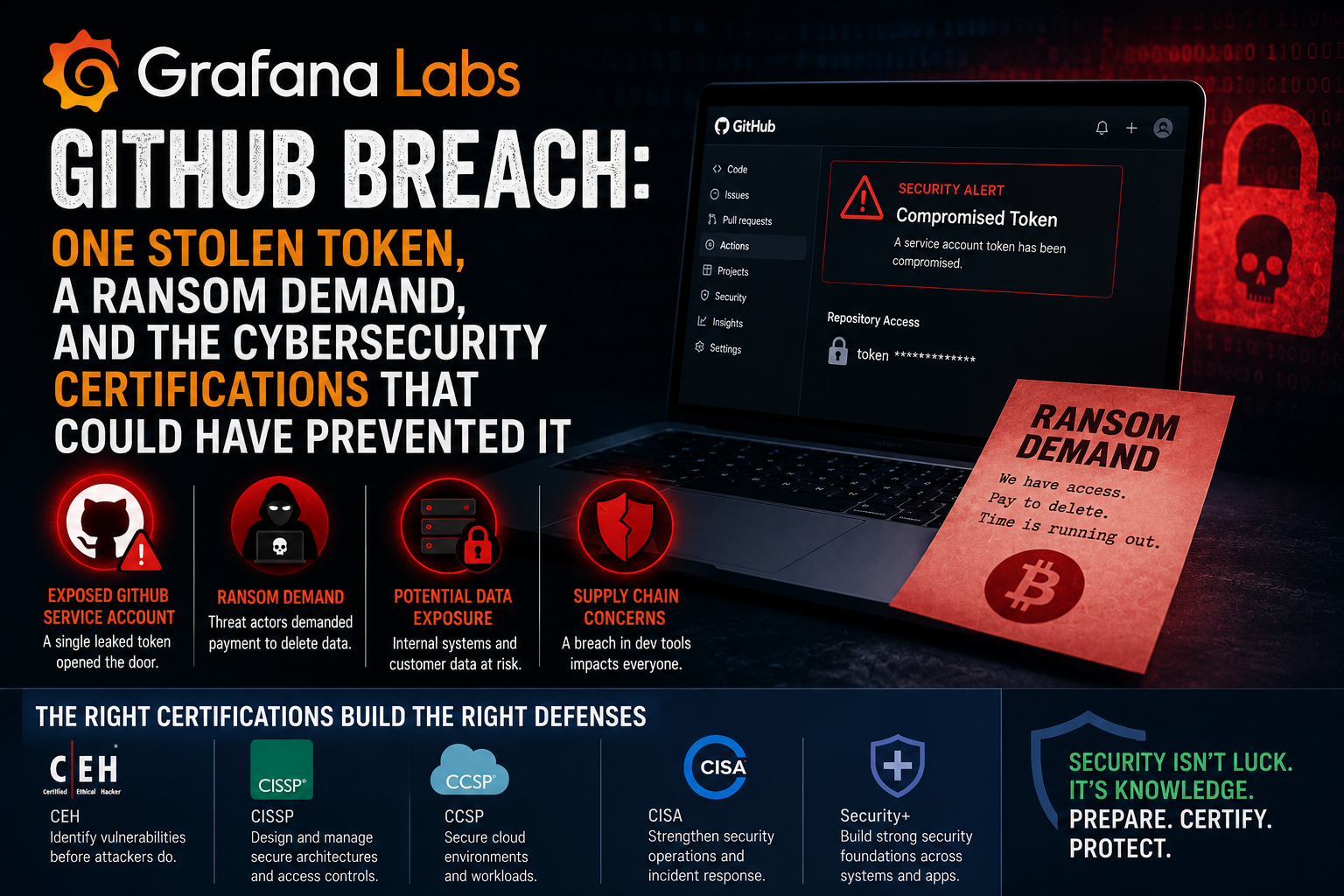
Grafana Labs GitHub Breach: One Stolen Token, a Ransom Demand, and the Cybersecurity Certifications That Could Have Prevented It
A single compromised token. That is all it took for an attacker to access Grafana Labs' GitHub repository, download its proprietary source code, and issue a ransom demand threatening to release it publicly unless the company paid up. Grafana refused to pay — and was in a position to do so because no customer data was exposed and the breach had no impact on operations. But the incident is a textbook example of one of the most common and preventable attack vectors in enterprise cybersecurity: credential theft. For IT professionals working in development environments, DevOps pipelines, cloud platforms, and security operations, the Grafana breach is a case study worth examining closely — and a reminder of exactly why cybersecurity certifications are not optional extras but foundational career requirements.
What Happened: The Grafana Labs GitHub Breach
Grafana Labs — the company
behind the widely used open-source observability platform Grafana — disclosed
that an unauthorised party obtained a token granting access to its GitHub
environment. Using that token, the attacker accessed Grafana's source code repositories
and exfiltrated code, including proprietary code not publicly available through
Grafana's open-source releases.
The attacker then threatened to
release the stolen code publicly unless Grafana paid a ransom. Grafana declined
— citing both the FBI's published guidance on ransomware payments and its own
operational assessment that the breach did not expose customer data or impact
customer systems.
The full incident at a glance:
|
Factor |
Detail |
|
Attack
Vector |
Stolen GitHub access token
(compromised credential) |
|
What Was
Accessed |
Grafana's private source
code repository |
|
Customer
Data Stolen |
None — confirmed by Grafana |
|
Operations
Impacted |
None reported |
|
Attacker
Demand |
Ransom payment in exchange
for not releasing stolen code |
|
Grafana's
Response |
Refused to pay ransom;
invalidated credentials; added security measures |
|
Code
Exposure Risk |
Mitigated — much of
Grafana's codebase is already open source |
|
Contrast
Case |
Canvas (edtech firm) paid
ransom after 275M+ student records stolen |
Grafana stated it believes it
has identified the source of the credential leak, has invalidated the
compromised credentials, and has implemented additional security measures. The
company's relatively calm response to a serious breach was made possible by one
critical factor: the attacker reached the code but not the customers.
Grafana's Decision Not to Pay: The Right Call — and Why
Grafana's refusal to pay the
ransom is significant and worth unpacking. The company cited the FBI's own
published guidance directly:
Paying a ransom doesn't guarantee you or your organization will
get any data back and only offers an incentive for others to get involved in
this type of illegal activity. — FBI, cited by Grafana Labs
This reflects the consensus
position among law enforcement agencies and cybersecurity professionals
globally: ransom payments fund criminal operations, incentivise future attacks,
and provide no reliable guarantee of data recovery or non-publication. The FBI,
the UK's National Cyber Security Centre (NCSC), and Europol all advise against
payment.
Grafana's ability to hold this
principled position was, however, significantly aided by circumstance. The
company's determination that no customer data was accessed and no customer
systems were affected removed the most serious pressure that typically forces
organisations to consider payment. The contrast with Canvas — an education
technology firm that paid extortionists after they claimed to have stolen data
describing over 275 million students and faculty — illustrates how different
the calculus becomes when personal data is involved.
The Grafana case also raises an
interesting question about the nature of the threat itself. Much of Grafana's
product portfolio is already open source — available for anyone to download
from public repositories. If the attacker primarily accessed code that is
already publicly available, the ransom leverage is significantly diminished.
The Register has sought clarification on precisely what proprietary code was
accessed.
How the Attack Happened: The Credential Theft Attack Vector
The Grafana breach followed one
of the most common attack patterns in enterprise cybersecurity: credential
theft leading to unauthorised access. The specific mechanism — a compromised
token granting GitHub access — is a variant of this pattern that is particularly
prevalent in software development and DevOps environments.
Developer environments are rich
targets for credential theft because they typically involve:
•
A large number of access tokens, API keys, and
credentials used by developers, CI/CD pipelines, automation tools, and
third-party integrations
•
High-volume, high-frequency access activity that makes
anomalous token use harder to detect against the background noise of normal
operations
•
Broad permissions — developer tokens frequently have
read and write access to entire repositories because restricting them adds
friction to development workflows
•
Long token lifespans — tokens are often created and
then not rotated for months or years, extending the window of exposure if they
are compromised
•
Third-party integrations — tokens shared with
third-party tools (CI/CD platforms, code quality tools, package managers)
expand the attack surface beyond the organisation's direct control
The GitHub environment is a
particularly high-value target. Source code repositories contain not only the
code itself but frequently also hardcoded secrets — API keys, database
credentials, cloud access tokens — that developers inadvertently commit to version
control. GitHub's own secret scanning feature exists specifically to detect and
alert on this pattern, but it requires configuration and active monitoring to
be effective.
The Security Controls That Could Have Prevented or Limited This Breach
The Grafana breach was
preventable — or at minimum could have been significantly limited — by a set of
security controls that are well-understood, widely documented, and directly
covered by the cybersecurity certifications that Certizon offers. Here is the
gap analysis:
|
Attack
Factor |
Security
Control That Would Have Helped |
|
Stolen
Access Token |
Token lifecycle management
— rotate credentials regularly, set expiry, monitor for anomalies |
|
GitHub
Repository Access |
Least-privilege access
controls — only grant repository permissions to those who genuinely need them |
|
No
Multi-Factor Authentication |
MFA enforcement on all
developer accounts and CI/CD service accounts |
|
Delayed
Detection |
Secret scanning and SIEM
monitoring — detect token use anomalies in real time |
|
Ransom
Demand |
Incident response planning
— know your response protocol before an attack occurs |
|
Ransom
Payment Pressure |
Cyber insurance and legal
counsel — understand your obligations and options in advance |
Each of these controls is
standard practice in a mature security organisation. Each is taught, assessed,
and certificated across multiple cybersecurity certification programmes. The
Grafana breach is not evidence of a sophisticated, unprecedented attack — it is
evidence of a credential management gap that certified security professionals
are specifically trained to identify and close.
Ransom vs. Refusal: Understanding the Incident Response Decision
One of the most instructive
aspects of the Grafana incident is the organisation's incident response
decision-making. Grafana made the call not to pay quickly and publicly, citing
both principle and operational assessment. This decision reflects a mature incident
response framework — something that does not happen by accident.
Effective incident response
planning covers:
•
Pre-defined decision trees — organisations that have
planned their response to ransomware before an incident occurs make better
decisions under pressure than those improvising in real time
•
Operational impact assessment — Grafana's ability to
quickly confirm no customer data was exposed and no operations were affected
reflects mature logging, monitoring, and data classification practices
•
Legal and regulatory clarity — understanding
obligations to customers, regulators, and law enforcement before an incident is
the difference between a measured response and a chaotic one
•
Communication strategy — Grafana's transparency in
disclosing the incident via social media reflects an understanding that
controlled, honest disclosure is better for reputation than silence followed by
external exposure
•
FBI and NCSC alignment — organisations that are
familiar with law enforcement guidance on ransomware payments before an
incident are better positioned to follow that guidance under the pressure of an
active attack
The contrast with Canvas — which
paid the ransom despite the FBI's guidance — illustrates how different the
decision becomes when personal data belonging to tens of millions of
individuals is at risk. Data classification is a core security competency precisely
because the severity of a breach, and therefore the response options available,
depends critically on what data was accessed.
The Certifications That Build These Security Capabilities
The skills needed to prevent,
detect, and respond to credential theft attacks like the one Grafana
experienced are not innate — they are learned, practised, and validated through
certification. Here are the certifications most directly relevant to the Grafana
case:
|
Certification |
Why It Is
Relevant to the Grafana Incident |
|
CompTIA
Security+ |
Foundational cybersecurity
— covers credential management, access controls, and incident response. The
baseline certification for any professional responsible for securing
developer environments. |
|
Certified
Ethical Hacker (CEH) |
Teaches offensive security
thinking — understanding how attackers steal tokens and compromise GitHub
accounts so defenders can anticipate and block these methods. |
|
CISSP |
Strategic security
management — covers identity and access management (IAM), asset security, and
security operations at an enterprise level. Ideal for security architects and
managers. |
|
CompTIA
CySA+ |
Cybersecurity analyst
credential — focuses on threat detection, behavioural analytics, and incident
response. Directly relevant to detecting anomalous token usage like Grafana's
attack. |
|
GitHub
Advanced Security (GHAS) |
Microsoft/GitHub credential
covering secret scanning, code scanning, and dependency review — the
technical tools that detect and prevent exactly the kind of credential leak
Grafana suffered. |
|
Certified
Cloud Security Professional (CCSP) |
Cloud and DevOps security —
covers securing cloud-hosted repositories, CI/CD pipelines, and secrets
management in multi-cloud environments. |
|
CISM
(Certified Information Security Manager) |
Management-level credential
covering incident response, risk management, and information security
governance — essential for professionals designing the policies that prevent
credential misuse. |
|
ISO/IEC
27001 Lead Implementer |
Information security
management systems — the international standard for building the
organisational security controls that prevent, detect, and respond to
incidents like Grafana's breach. |
The Broader Context: Source Code as a High-Value Target
The Grafana breach is part of a
broader pattern of attacks targeting software development infrastructure.
Source code repositories have become high-value targets for several overlapping
reasons:
•
Intellectual property value — proprietary source code
represents years of engineering investment. For competitors or nation-state
actors, accessing a company's codebase provides insight into architecture,
algorithms, and capabilities that would otherwise take years to develop
independently
•
Hardcoded secrets — developers frequently commit API
keys, database passwords, cloud credentials, and other sensitive material to
version control, often temporarily, creating persistent exposure even after the
material is removed from the active codebase
•
Supply chain attack potential — access to a software
vendor's source code creates the possibility of inserting malicious code into
software updates distributed to customers — a supply chain attack of the type
seen in the SolarWinds breach
•
Ransomware leverage — as Grafana experienced, stolen
code can be used as ransomware leverage even when customer data is not
involved, because organisations value protecting proprietary technology
The 2020 SolarWinds attack — in
which attackers inserted malicious code into a software update distributed to
thousands of organisations including US government agencies — established that
software development environments are among the most critical infrastructure an
organisation operates. Since then, attacks targeting GitHub repositories, CI/CD
pipelines, and developer credentials have increased significantly.
What DevOps and Development Teams Should Do Now
For IT professionals working in
development, DevOps, and platform engineering roles, the Grafana breach is a
prompt to audit the security of their own environments. Here is a practical
security checklist informed by the lessons of this incident:
•
Audit all active tokens — list every personal access
token, OAuth token, and service account credential with access to your GitHub
organisation. Revoke any that are unused, expired, or have broader permissions
than necessary
•
Enable GitHub secret scanning — GitHub's built-in
secret scanning detects common patterns of hardcoded credentials in
repositories and alerts administrators. Enable it on all repositories,
including private ones
•
Implement least-privilege access — review repository
permissions and ensure that tokens, service accounts, and user accounts only
have the access level they genuinely require
•
Set token expiry — configure mandatory expiry for all
personal access tokens. Short-lived tokens (30 to 90 days) significantly reduce
the exposure window if a token is compromised
•
Enable SIEM monitoring for GitHub — integrate GitHub
audit logs with your security information and event management (SIEM) platform
to detect anomalous access patterns in real time
•
Review third-party integrations — audit which
third-party tools have OAuth access to your GitHub organisation and revoke
access for any tool that is no longer actively used
•
Enable MFA across all developer accounts — mandatory
multi-factor authentication on all accounts with repository access is the
single most effective control against credential theft
•
Test your incident response plan — run a tabletop
exercise simulating a credential theft and source code exfiltration. Identify
gaps in your detection, response, and communication processes before an actual
incident occurs
Frequently Asked Questions
Q1: What happened in the Grafana Labs GitHub breach?
An unauthorised attacker
obtained an access token granting entry to Grafana Labs' GitHub environment and
used it to exfiltrate source code from the company's repositories. The attacker
then demanded a ransom, threatening to publicly release the stolen code.
Grafana refused to pay, confirmed no customer data was accessed, invalidated
the compromised credentials, and implemented additional security measures.
Q2: Why did Grafana refuse to pay the ransom?
Grafana cited the FBI's
published guidance — that paying ransoms does not guarantee data recovery and
creates incentives for further criminal activity — and its own assessment that
no customer data was exposed and no customer operations were impacted. The
company's open-source-heavy product portfolio also reduced the leverage value
of the stolen code.
Q3: How did the attacker access Grafana's GitHub repositories?
The attacker obtained a
compromised access token that granted access to Grafana's GitHub environment.
Grafana stated it believes it has identified the source of the credential leak.
The specific origin of the token compromise has not been publicly disclosed.
Q4: What security controls prevent this type of attack?
Key preventive controls include
mandatory multi-factor authentication on all developer accounts, short-lived
access tokens with regular rotation, least-privilege repository permissions,
real-time monitoring of access logs via SIEM integration, GitHub secret
scanning to detect hardcoded credentials, and regular audits of third-party
integrations with repository access.
Q5: What certifications prepare IT professionals for credential theft
threats?
The most relevant certifications
include CompTIA Security+ (foundational security), Certified Ethical Hacker
(CEH), CISSP, CompTIA CySA+ (threat detection and incident response), GitHub
Advanced Security, Certified Cloud Security Professional (CCSP), CISM, and
ISO/IEC 27001 Lead Implementer. Certizon offers programmes across all of these
tracks.
Q6: How does this incident compare to other recent breaches?
The Grafana breach is a
lower-severity outcome than many credential theft incidents because no customer
data was involved. The contrasting case is Canvas (edtech), which paid a ransom
after attackers claimed to have stolen data on over 275 million students and
faculty — a vastly higher-stakes situation because personal data creates legal,
regulatory, and reputational obligations that code theft alone does not.
Build the Cybersecurity Skills That Prevent Breaches Like Grafana's
The Grafana Labs GitHub breach
was caused by a compromised token — a preventable credential management
failure. The security controls that would have stopped or limited this attack
are well-established, widely taught, and directly certificated. For IT professionals
working in development, DevOps, security operations, or infrastructure roles,
this incident is a reminder that credential security is not a niche specialism
— it is a foundational responsibility.
Certizon's cybersecurity
certification programmes — from CompTIA Security+ to CISSP, from CEH to GitHub
Advanced Security — equip IT professionals with the technical depth, governance
knowledge, and incident response capability to build environments that are
harder to breach and faster to recover when breaches occur.
Visit certizon.com to explore our full cybersecurity
certification catalogue, access free trial courses, and speak with a career
advisor today.
One stolen token caused the Grafana breach. One certification can teach you to stop the next one.