
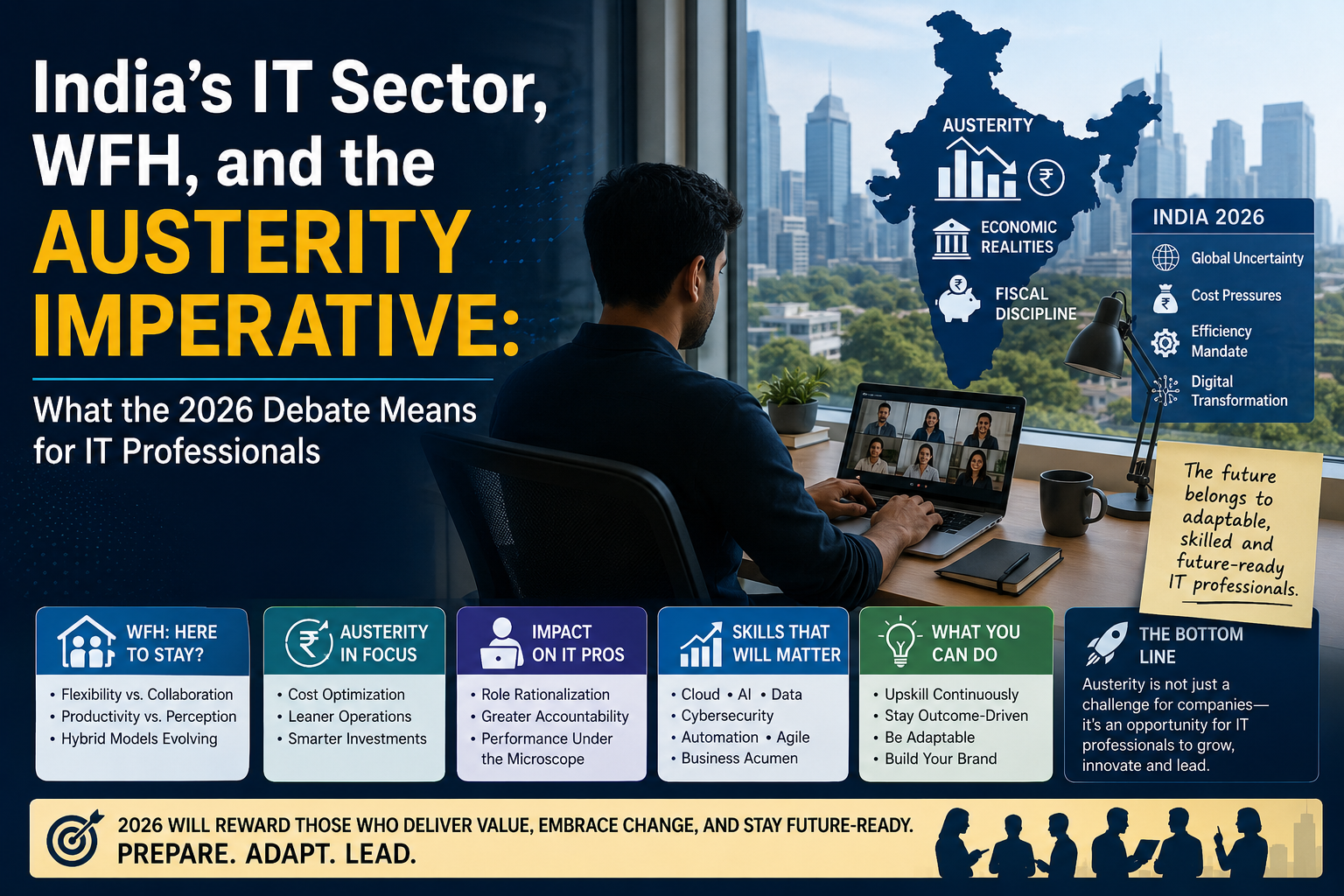
India's IT Sector, WFH, and the Austerity Imperative: What the 2026 Debate Means for IT Professionals
India's work-from-home debate is back — but this time, the reasons are very different. During the COVID pandemic, WFH was a health necessity. In 2026, the conversation is being driven by economics: rising crude oil prices, supply disruptions, a widening import bill, and government concern about forex reserve preservation. Prime Minister Narendra Modi has urged businesses to adopt WFH wherever possible, and India Inc — including the 5.5-million-strong IT sector — is taking the question seriously. But as industry analysts and IT leaders are pointing out, the answer is not as simple as flipping back to the 2020 playbook. The debate over WFH is, at its core, a debate about cost efficiency, operational discipline, and the smarter use of technology. And for IT professionals, it is also a signal about which skills and certifications are becoming more valuable, not less, in a period of economic austerity.
The Context: Why WFH Is Back on the Agenda
The trigger for the 2026 WFH
debate is macroeconomic, not epidemiological. India is facing a combination of
pressures:
•
Crude oil prices have surged, significantly increasing
India's import bill — oil is India's single largest import category
•
Global supply disruptions have added further pressure
on the current account
•
The government is focused on preserving forex reserves,
which requires reducing non-essential import spending
•
Fuel consumption by commuters — including millions of
IT professionals commuting daily to tech parks across Bengaluru, Hyderabad,
Pune, Chennai, and NCR — is a meaningful component of India's urban fuel demand
In this context, Prime Minister
Modi's call for businesses to adopt WFH wherever possible is a pragmatic fiscal
measure. If a significant proportion of India's 5.5 million IT professionals
could eliminate their daily commute, the aggregate impact on fuel consumption
and import expenditure would be material.
With more than 5.5 million direct employment, the Indian IT
industry has been one of the largest employers in the Indian economy. During
the COVID pandemic, this critical industry successfully operated in remote
mode, serving clients worldwide — with no major cybersecurity breaches or work
disruption.
Why the IT Industry Is Hesitant: The Case Against Full WFH in 2026
Despite the government's
advisory and the industry's demonstrated ability to work remotely during COVID,
Indian IT companies are not rushing to return to full WFH. The reasons are
substantive and worth understanding carefully.
1. This Is a Supply-Side Problem, Not a Mobility Restriction
The most important distinction
between 2020 and 2026 is the nature of the crisis. COVID WFH was driven by
legally mandated mobility restrictions — companies had no choice but to operate
remotely. The 2026 scenario is different: the government is asking businesses
to voluntarily reduce commuting to ease import pressure. There is no mandate,
no lockdown, and no health emergency. Industry experts therefore argue that the
current hybrid model — where employees commute to office on some days and work
remotely on others — already provides meaningful fuel savings without requiring
a full operational reset.
2. The Transition Cost Is Real
Going back to full remote mode
is not free. Companies that have invested in returning employees to offices —
setting up hybrid workflows, rebuilding in-person collaboration norms,
renegotiating real estate, and reconfiguring IT infrastructure — would face
significant transition costs to reverse those investments. Project access
systems, VPN configurations, equipment logistics, and security policy updates
all cost time and money. For large IT firms managing thousands of projects
simultaneously, these are not trivial overheads.
3. Hybrid Is Working — Full WFH May Break What Is Not Broken
Many of India's leading IT
companies — TCS, Infosys, Wipro, HCL Technologies, and others — have settled
into hybrid models that balance the productivity benefits of in-person
collaboration with the flexibility that employees value. Disrupting a functioning
hybrid workflow to return to full remote mode risks introducing the very
inefficiencies that took years to overcome after COVID.
4. The Cybersecurity Landscape Has Changed
During COVID, India's IT sector
executed the WFH transition with remarkable speed and, critically, without
major cybersecurity incidents. But the threat landscape in 2026 is
significantly more complex than it was in 2020. AI-powered cyberattacks,
sophisticated phishing, ransomware-as-a-service, and nation-state intrusion
campaigns have all escalated dramatically. A full return to remote work — with
millions of employees accessing enterprise systems from home networks of
varying security quality — would present a substantially larger attack surface
than existed in 2020.
COVID WFH vs. 2026 WFH Debate: A Side-by-Side Comparison
|
Factor |
COVID WFH (2020-22) |
WFH Debate 2026 |
|
Trigger |
Health crisis — mobility
restrictions to curb disease |
Economic — reducing fuel
imports and forex outflow |
|
Industry
Readiness |
High — tools and culture
adapted quickly |
Moderate — hybrid model
already embedded; full WFH is disruptive |
|
Government
Push |
Mandated lockdowns forced
the shift |
Advisory from PM Modi —
voluntary for businesses |
|
Workflow
Impact |
Fresh transition — new
processes built from scratch |
Regression — would undo
current hybrid workflows |
|
Cybersecurity
Risk |
No major breaches reported
during COVID WFH |
Risk landscape more complex
in 2026 with AI-powered threats |
|
Employee
Preference |
WFH widely welcomed during
pandemic |
Mixed — many IT
professionals prefer current hybrid model |
|
Industry
Position |
Full WFH adopted by
necessity |
Hybrid preferred; full WFH
seen as unnecessary disruption |
The Austerity Alternative: A Smarter Path for IT Companies
The Hans India editorial makes a
critical point that deserves amplification: the IT sector's most effective
response to India's economic challenge may not be WFH — it may be austerity.
Smart operational cost reduction, applied consistently across large IT
organisations, can deliver significant forex savings without the disruption of
a full work-model transition.
Here are the austerity levers
that Indian IT companies can pull immediately:
|
Austerity
Lever |
How IT
Companies Can Apply It |
|
Travel
Policy Reform |
Replace business travel
with high-quality video conferencing; restrict non-essential flights and
hotel stays |
|
Office
Energy Optimisation |
Smart building management,
LED retrofits, HVAC scheduling tied to actual occupancy under hybrid model |
|
Cloud Cost
Governance |
FinOps practices —
rightsizing cloud instances, eliminating idle resources, reserved pricing
strategies |
|
Vendor
Renegotiation |
Audit SaaS subscriptions,
consolidate redundant tools, renegotiate contracts with strategic vendors |
|
AI-Powered
Productivity |
Use AI tools to do more
with fewer headcount additions — reducing indirect payroll cost growth |
|
Procurement
Discipline |
Centralised procurement,
bulk purchasing, and longer-term contracts with hardware and services vendors |
|
Flexible
Real Estate |
Optimise office footprint
under hybrid — sublease underused floors rather than maintaining
full-occupancy costs |
Each of these levers reduces
operational expenditure and import-linked costs — whether through lower fuel
consumption on business travel, reduced energy imports for office operations,
or lower dollar-denominated SaaS and cloud spending. And critically, none of
them requires disrupting the hybrid workflow that Indian IT has spent three
years building.
The Skills That the Austerity and WFH Debate Makes More Valuable
Whether India's IT sector moves
toward greater WFH, deeper austerity, or a combination of both, the debate
highlights a set of skills and certifications that become more valuable in
either scenario. IT professionals who hold expertise in the following areas
will find themselves in higher demand as companies navigate this challenge:
Cloud Cost Management and FinOps
As IT companies look to reduce
cloud expenditure — one of the largest and fastest-growing cost lines in the
sector — professionals who understand cloud financial operations (FinOps) are
increasingly sought after. AWS,
Azure, and Google Cloud all offer cost
management certifications and tooling. The ability to rightsize infrastructure,
eliminate waste, and optimise cloud spend is a strategic capability that pays
for itself many times over.
Cybersecurity for Remote and Hybrid Environments
The cybersecurity risk of
expanded WFH is one of the strongest arguments industry experts are making
against a full remote transition. IT professionals certified in endpoint
security, zero-trust network architecture, VPN management, and cloud security
are essential for any organisation managing a distributed workforce safely.
Certifications including CompTIA
Security+, Certified
Ethical Hacker (CEH), CISSP, and Cisco CyberOps
are directly relevant to this challenge.
IT Infrastructure and Remote Access Management
If Indian IT companies do expand
WFH — even partially — they will need professionals who can configure, manage,
and troubleshoot remote access infrastructure at scale. This includes VPN and
SASE architecture, identity and access management (IAM), Microsoft Azure Active
Directory, Cisco networking,
and endpoint management platforms. CompTIA A+, CCNA,
and Microsoft
Azure Administrator certifications are directly applicable.
AI-Powered Productivity Tools
One of the strongest arguments
for austerity over WFH is that AI tools can dramatically boost productivity
without requiring additional headcount — effectively doing more with the
existing workforce. IT professionals who understand how to deploy, configure,
and govern AI productivity tools — including Microsoft 365 Copilot, GitHub
Copilot, and enterprise AI platforms — are valuable partners in any austerity
programme. Generative AI and AI Practitioner certifications from Certizon equip professionals with exactly
these skills.
Project and Workflow Management
Whether the work model is hybrid
or fully remote, the ability to manage complex IT projects effectively across
distributed teams is a premium skill. PMP
(Project Management Professional), PRINCE2, and Agile/Scrum certifications
equip IT professionals to maintain delivery quality and team cohesion
regardless of where team members are physically located.
Data Analytics and Business Intelligence
Austerity decisions — which
costs to cut, where to find efficiency, how to measure savings — require data.
IT professionals who hold certifications in data analytics, Power BI, Tableau,
or SQL-based analytics are positioned to lead the measurement and optimisation
programmes that austerity initiatives demand.
What This Means for IT Professionals: Career Positioning in a Period of
Austerity
Economic pressure on India's IT
sector — whether from crude oil prices, global supply disruptions, or client
budget constraints — historically produces the same pattern: companies invest
in professionals who can deliver more value per rupee. The IT professionals who
thrive in austerity periods are those who can:
•
Replace expensive processes with automated or
AI-assisted alternatives
•
Identify and eliminate technology waste — unused
licences, idle cloud resources, redundant vendor relationships
•
Secure distributed workforces against the elevated
cybersecurity risks of hybrid and remote operations
•
Keep complex projects on track across geographically
distributed teams
•
Measure, report, and optimise the cost and performance
of IT infrastructure
Every one of these capabilities
is certifiable. And every one of them is in higher demand in a period of
economic austerity than in a period of growth. For IT professionals who invest
in the right certifications now, the WFH and austerity debate is not a threat —
it is a career accelerator.
Frequently Asked Questions
Q1: Why is India's WFH debate back in 2026?
Prime Minister Narendra Modi has
urged businesses to adopt WFH wherever possible as a measure to reduce India's
fuel import bill and preserve forex reserves. Rising crude oil prices and
global supply disruptions have increased the economic case for reducing
commuter fuel consumption. The IT sector, with 5.5 million employees, is a
natural focus for this advisory.
Q2: Why is the IT industry hesitant to return to full WFH?
Industry experts cite several
reasons: the current hybrid model is functioning well and full WFH would
require costly workflow restructuring; the 2026 situation is not a mandated
lockdown but an advisory; the cybersecurity threat landscape is more complex
than during COVID; and companies have invested significantly in rebuilding
hybrid operational models that would be disrupted by a full remote transition.
Q3: What is the austerity alternative to WFH?
Industry analysts suggest that
IT companies can reduce costs and forex-linked expenditure more effectively
through operational austerity — cutting business travel, optimising cloud
spend, renegotiating vendor contracts, reducing office energy consumption, and
deploying AI productivity tools — without disrupting the hybrid work model that
is currently working well.
Q4: What certifications are most useful for IT professionals navigating
this period?
The most relevant certifications
include cloud cost management and FinOps credentials (AWS, Azure, GCP), cybersecurity
certifications for hybrid and remote environments (CompTIA Security+, CEH,
CISSP), IT infrastructure and remote access management credentials (CCNA, Azure
Administrator, CompTIA A+), AI productivity tool expertise (Generative AI,
Microsoft 365 Copilot), and project management certifications (PMP,
PRINCE2, Scrum Master).
Q5: How does Certizon support IT
professionals in India?
Certizon
offers fully online, self-paced globally recognised IT certification programmes
accessible to professionals across India. All programmes include
expert-designed curriculum, practice assessments, and mentor support, and can
be completed in four to twelve weeks without requiring time away from work.
Invest in Skills That Perform in Any Economic Environment
The WFH and austerity debate in
India's IT sector will evolve as the macroeconomic situation develops. But the
underlying principle is durable: IT professionals who hold globally recognised
certifications in cloud cost management, cybersecurity, AI productivity, and
infrastructure management deliver value in growth periods and in austerity
periods alike. Certified expertise is the most recession-resilient investment
an IT professional can make.
Certizon's globally recognised
IT certifications give you exactly that resilience. Visit certizon.com to explore our full certification
catalogue, access free trial courses, and speak with a career advisor today.
Economic cycles change.
Certified skills compound.