Microsoft's Life After OpenAI: The AI Acquisition Race and What It Means for Your IT Career in 2026
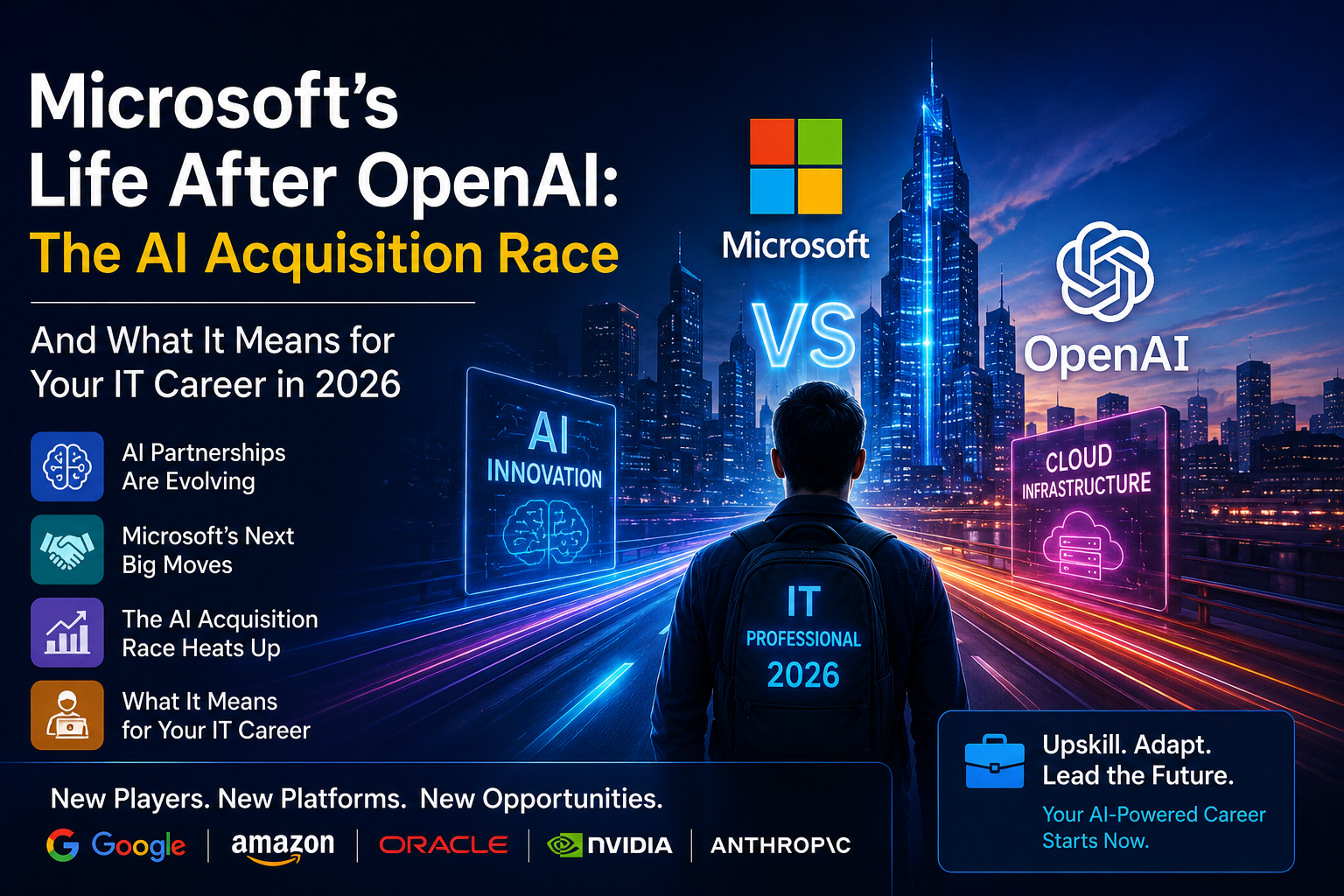
One of the most consequential relationships in the history of enterprise technology is quietly being renegotiated. Microsoft — which invested $11.8 billion into OpenAI and built much of its AI strategy around exclusive access to OpenAI's models — is now actively shopping for AI startups, exploring acquisition targets, and accelerating internal AI model development under Mustafa Suleyman, the co-founder of Google DeepMind. The story of Microsoft pivoting toward AI independence is not just a corporate strategy headline. It is a window into where the global technology industry is heading — and it has direct, practical implications for IT professionals who want to build careers that are resilient, relevant, and in demand across the next decade.
The Microsoft-OpenAI Partnership: From Breakthrough to Friction
To understand where Microsoft is
going, it helps to understand where it has been. When Microsoft invested $1
billion into OpenAI in 2019, the research lab was little-known outside academic
AI circles. The partnership gave Microsoft exclusive access to OpenAI's
technology and gave OpenAI the computing resources to pursue ambitious
research. For both parties, it was transformational.
The launch of ChatGPT in late
2022 changed everything. Overnight, Microsoft was positioned as the AI pioneer
of the enterprise world. OpenAI's models powered Bing's AI search revamp,
GitHub Copilot's code generation, Microsoft 365 Copilot's productivity tools,
and Azure OpenAI Service's enterprise offerings. By 2025, Microsoft had
committed $13 billion to OpenAI and spent more than $100 billion in total when
infrastructure and hosting costs are included.
But the relationship that looked
so clean in 2019 became increasingly complicated as both companies grew. OpenAI
found that its compute needs — for training ever-larger models — outstripped
what Microsoft could supply. Microsoft, meanwhile, was contractually barred
from building a foundation model that could compete with OpenAI's offerings.
Both sides chafed under restrictions that made sense in 2019 but felt
increasingly constraining by 2024.
Microsoft has spent more than $100 billion on its OpenAI
investments and its costs of building infrastructure and hosting. It has given
$11.8 billion of the promised $13 billion to OpenAI. — Michael Wetter,
Microsoft Corporate Development, in court testimony, May 2026
The Renegotiation: Two Companies Declaring Independence
The Microsoft-OpenAI
relationship has been amended multiple times, each iteration loosening the ties
that once defined it. The most significant changes came in late 2025 and April
2026:
•
Late 2025 amendment — Microsoft gained the right to
build Artificial General Intelligence (AGI), a still-theoretical advanced form
of AI capable of performing complex tasks better than a human. This was a
significant departure from the original contract, which effectively reserved
frontier model development for OpenAI.
•
April 2026 deal — OpenAI gained the freedom to build
some products in partnership with Microsoft's direct rivals, including Amazon
Web Services. This effectively ended the exclusivity that had defined the
partnership's early years.
These amendments represent a
managed decoupling — two companies that became dependent on each other working
carefully to restore their strategic freedom without destroying the
relationship entirely. Microsoft still runs OpenAI models on Azure. OpenAI still
relies on Microsoft infrastructure for much of its compute. But both are now
building the capability to operate independently, and Microsoft's acquisition
activity reflects the urgency of that effort.
The Startup Shopping Spree: Cursor, Inception, and the AI Talent War
Microsoft's response to its
evolving OpenAI relationship is an aggressive pursuit of AI startup talent and
technology. Two deals have emerged as particularly revealing:
Cursor: The Code-Generation Deal That Fell Through
This spring, Microsoft weighed
acquiring Cursor — a code-generation startup that has become one of the most
talked-about developer tools in the AI era. Cursor's product allows developers
to write, edit, and debug code through a conversational AI interface, and it
has attracted a passionate user base among software engineers. Microsoft's
interest was clear: Cursor's capabilities would complement and potentially
supercharge GitHub Copilot, Microsoft's existing AI coding tool.
But Microsoft walked away.
Internal concerns concluded that acquiring Cursor would not pass regulatory
scrutiny, given Microsoft's ownership of GitHub Copilot. A combined
Microsoft-Cursor entity would have an extraordinarily dominant position in
AI-assisted code generation — a position that competition regulators in the US
and EU were deemed likely to challenge. SpaceX (operating through its
acquisition of Elon Musk's xAI) stepped in and announced a deal with Cursor
shortly after Microsoft withdrew. The episode illustrates both the intensity of
the AI talent acquisition race and the regulatory constraints that large
incumbents now face.
Inception: Diffusion Models and the $1 Billion Bet
The more consequential active
deal is Microsoft's ongoing discussions with Inception — a small but
technically ambitious startup founded in mid-2024 by a Stanford University
team. Inception is working on a fundamentally different approach to generating
text using AI, based on a technique called diffusion.
Standard large language models
generate text one token at a time — predicting each word based on everything
that came before it. Inception's diffusion-based approach generates and refines
multiple tokens simultaneously, in a process more commonly used to create AI
images and videos. This can significantly boost the model's speed. If the
technique scales — and that remains an open question, as diffusion can be
unpredictable with very large models — it could offer a meaningful advantage in
applications where response latency matters.
Microsoft's M12 venture fund
invested in Inception's $50 million seed round in late 2025. The discussions
now under way represent a potential full acquisition. Inception has hired a
bank to help negotiate the deal and is seeking a valuation of over $1 billion.
SpaceX has also courted Inception, making this a genuine bidding situation
between two of the most acquisitive technology companies in the AI space.
AI researchers can easily command tens of millions of dollars or
more in compensation. Startup valuations are soaring as investors scramble for
positions in promising AI technology.
Microsoft and OpenAI: The Full Timeline
|
Date |
Event |
|
2019 |
Microsoft invests $1B into
then-unknown OpenAI research lab |
|
Nov 2022 |
OpenAI launches ChatGPT —
Microsoft anointed as AI pioneer; Azure growth surges |
|
2023 |
Microsoft invests
additional billions; deploys OpenAI models across Office 365, Bing, Azure |
|
2024 |
Tensions grow — OpenAI's
compute needs outstrip Microsoft's supply; contract restrictions chafe both
sides |
|
Late 2025 |
Amended deal allows
Microsoft to build Artificial General Intelligence (AGI) |
|
Late 2025 |
Microsoft's M12 venture
fund invests in Inception's $50M seed round |
|
Early 2026 |
Microsoft considers
acquiring Cursor — walks away over GitHub Copilot regulatory concerns |
|
Early 2026 |
SpaceX (xAI) acquires
Cursor shortly after Microsoft withdraws |
|
April 2026 |
OpenAI and Microsoft
renegotiate — OpenAI gains freedom to work with Amazon and other rivals |
|
May 2026 |
Microsoft in active
discussions to acquire Inception (valued at $1B+); AI acquisition strategy
accelerates |
Mustafa Suleyman and the Internal AI Frontier
Alongside its external
acquisition activity, Microsoft is building internal AI capabilities at the
highest level. Mustafa Suleyman — co-founder of Google DeepMind and one of the
most respected AI researchers and executives in the world — leads Microsoft's
internal AI teams. His mandate is to build frontier AI models that can
eventually stand alongside or ahead of OpenAI's offerings.
Suleyman joined Microsoft in
2024 after leading the development of some of DeepMind's most celebrated
research, including AlphaGo, AlphaFold, and the Gemini model series. His
presence at Microsoft signals the seriousness of the company's ambition to be a
first-party AI model developer, not merely a distributor of OpenAI's
technology.
The combination of Suleyman's
internal team, potential acquisitions like Inception, and Microsoft's
unrivalled Azure infrastructure positions the company to make a serious run at
the frontier model space. The target, according to sources familiar with the
strategy, is to have a cutting-edge AI model of its own by 2027.
For context on the scale of the
challenge: some of the most advanced AI labs are currently building models with
around 10 trillion parameters — a measure of model sophistication. That is up
from approximately 1 trillion parameters just three years ago. The parameter
arms race is expensive, computationally intensive, and requires exactly the
kind of specialised AI engineering talent that Microsoft is now aggressively
acquiring through startup deals and direct hiring.
What This Means for IT Professionals: The Microsoft AI Skills Opportunity
Microsoft's pivot — from OpenAI
dependency to independent AI capability — creates one of the most significant
skills opportunities in enterprise technology. Every layer of Microsoft's AI
strategy, from Azure infrastructure to GitHub Copilot to Microsoft 365 Copilot
to frontier model development, requires certified professionals who understand
the platform deeply.
The companies and teams that
will benefit most from Microsoft's AI investments are those staffed by
professionals who hold recognised Microsoft certifications and have hands-on
experience with the Azure AI ecosystem. Here are the certification tracks that
matter most:
|
Track |
Certifications |
Why It
Matters |
|
Azure AI
& Cloud |
Azure AI Engineer Associate,
Azure Solutions Architect, AZ-900 |
Microsoft is building its
own frontier AI on Azure — Azure expertise is the foundation for everything |
|
AI &
LLM Engineering |
AI Practitioner, ML
Engineer, Generative AI Specialist |
Microsoft needs AI
researchers and engineers to build models beyond OpenAI's technology |
|
GitHub
& DevOps |
GitHub Foundations, GitHub
Actions, Azure DevOps |
GitHub Copilot is
Microsoft's flagship AI coding product — DevOps and coding AI skills are
critical |
|
Cybersecurity |
SC-900, AZ-500, CompTIA
Security+, CISSP |
Security is embedded in
Microsoft's AI strategy across Azure, Defender, and Sentinel platforms |
|
Microsoft
365 & Copilot |
MS-900, MD-102, Microsoft
365 Certified Administrator |
Copilot for Microsoft 365 is
the consumer face of Microsoft AI — M365 admins manage its rollout |
|
Data &
Analytics |
DP-900, DP-203, Microsoft
Fabric, Power BI |
AI models depend on data
infrastructure — Fabric and Power BI are Microsoft's data AI platform |
|
Prompt
Engineering |
Prompt Engineering, AI
Product Management |
As Microsoft deploys AI
across all products, professionals who can design effective AI workflows are
in demand |
The Broader Implication: AI Independence Is the Industry Trend
Microsoft's move toward AI
independence is not an isolated corporate strategy — it is part of a broader
pattern playing out across the technology industry. Just as Microsoft is
reducing its dependence on OpenAI, other technology companies are making similar
moves:
•
Google is advancing Gemini as a direct competitor to
GPT-4 and beyond, reducing its clients' dependence on any single AI provider
•
Amazon is investing in Anthropic while also developing
its own Nova model series through AWS
•
Apple is building on-device AI capabilities through
Apple Intelligence, reducing dependence on cloud AI providers
•
Meta is open-sourcing its Llama model series, enabling
enterprises to build and deploy AI without vendor lock-in
•
SpaceX (xAI) is building Grok and acquiring companies
like Cursor to create a vertically integrated AI stack
For IT professionals, this
fragmentation of the AI landscape is both a challenge and an opportunity. The
challenge is that there is no single platform to master — the ecosystem is
diverse and fast-moving. The opportunity is that every one of these platforms
needs professionals who can deploy, secure, integrate, and optimise its AI
capabilities. Multi-platform expertise, validated by certifications across
cloud providers and AI frameworks, is the most durable career positioning
available.
India and Asia: Prime Beneficiaries of the Microsoft AI Expansion
Microsoft's AI expansion has
particular significance for IT professionals in India and across Asia.
Microsoft operates one of the largest research and development footprints in
India, with major engineering centres in Hyderabad, Bengaluru, and Noida. The
company has announced billions in India cloud infrastructure investment over
2025 and 2026, expanding Azure data centre capacity to meet the surging demand
from Indian enterprises adopting AI.
Indian IT services firms — TCS,
Infosys, Wipro, HCL Technologies, and Cognizant — are all deep Microsoft
partners, delivering Azure implementation, Microsoft 365 administration, and
Copilot deployment services to enterprise clients globally. As Microsoft
expands its AI portfolio — whether through acquisitions like Inception or
internal development under Suleyman — the demand for Microsoft-certified
professionals in India's IT services sector will grow in direct proportion.
Certizon's online certification
programmes allow IT professionals across India and Asia to earn Microsoft
Azure, AI, and Microsoft 365 credentials from anywhere — positioning themselves
for opportunities in the Microsoft AI ecosystem that are growing faster than
the talent pool to fill them.
Frequently Asked Questions
Q1: Why is Microsoft reducing its dependence on OpenAI?
The Microsoft-OpenAI
partnership, while transformational, created constraints for both companies.
Microsoft was contractually restricted from building competing foundation
models, while OpenAI found its compute needs outstripping Microsoft's supply.
Successive contract amendments have loosened these ties, and Microsoft is now
building internal AI capability under Mustafa Suleyman while pursuing startup
acquisitions to accelerate its independent frontier model ambitions.
Q2: What is Inception and why does it matter?
Inception is a Stanford-founded
AI startup working on diffusion-based large language models — a technique that
generates multiple text tokens simultaneously rather than one at a time,
potentially offering significant speed advantages. Microsoft's M12 fund
invested in Inception's $50 million seed round in late 2025, and the two
companies are now in acquisition discussions. Inception is valued at over $1
billion and is also being courted by SpaceX.
Q3: Why did Microsoft walk away from acquiring Cursor?
Microsoft weighed acquiring
Cursor — an AI-powered code-generation tool — but concluded internally that the
deal would face significant regulatory scrutiny, given Microsoft's existing
ownership of GitHub Copilot. A combined Microsoft-Cursor entity would have a
dominant position in AI-assisted coding. SpaceX (operating through xAI)
subsequently acquired Cursor.
Q4: Who is Mustafa Suleyman and what is his role at Microsoft?
Mustafa Suleyman is the
co-founder of Google DeepMind, where he led the development of AlphaGo,
AlphaFold, and contributed to the Gemini model series. He joined Microsoft in
2024 to lead internal AI development. His mandate is to build Microsoft's own
cutting-edge frontier AI models, reducing the company's dependence on OpenAI's
technology.
Q5: What Microsoft certifications are most valuable in 2026?
The most in-demand Microsoft
certifications in 2026 include Azure AI Engineer Associate (AI-102), Azure
Solutions Architect Expert (AZ-305), GitHub Foundations and GitHub Actions
credentials, Microsoft Security certifications (SC-900, AZ-500), Microsoft 365
Certified Administrator, and Microsoft Fabric and Power BI data certifications.
Certizon offers programmes across all of these tracks.
Q6: How does Certizon help IT professionals prepare for the Microsoft AI
ecosystem?
Certizon offers globally
recognised certification programmes covering the full Microsoft AI stack — from
Azure fundamentals to advanced AI engineering, from GitHub DevOps to Microsoft
365 Copilot administration. All programmes are fully online, self-paced, and
designed to be completed in four to twelve weeks, with expert curriculum,
practice assessments, and career mentoring.
Build Microsoft AI Expertise With Certizon
Microsoft's pivot toward AI
independence is one of the most significant corporate strategy shifts in
enterprise technology in years. The skills it demands — Azure AI engineering,
GitHub DevOps, Microsoft 365 Copilot administration, cloud security, and data
platform expertise — are certifiable today and in demand globally. Whether
Microsoft acquires Inception, builds its frontier model under Suleyman, or
pursues both paths simultaneously, the professionals who will lead the
enterprise AI era are those who understand the Microsoft ecosystem deeply and
can prove it with recognised credentials.
Certizon's globally recognised
IT certification programmes give you exactly that foundation. Visit certizon.com to explore our full certification
catalogue, start a free trial, and speak with a career advisor today.
Microsoft is building its
AI future. Certified professionals are the ones who will deliver it.