
The New Cyber Reality: AI, Cloud & the Age of Constant Attacks
Cyber warfare is no longer an occasional threat—it has become a constant reality.
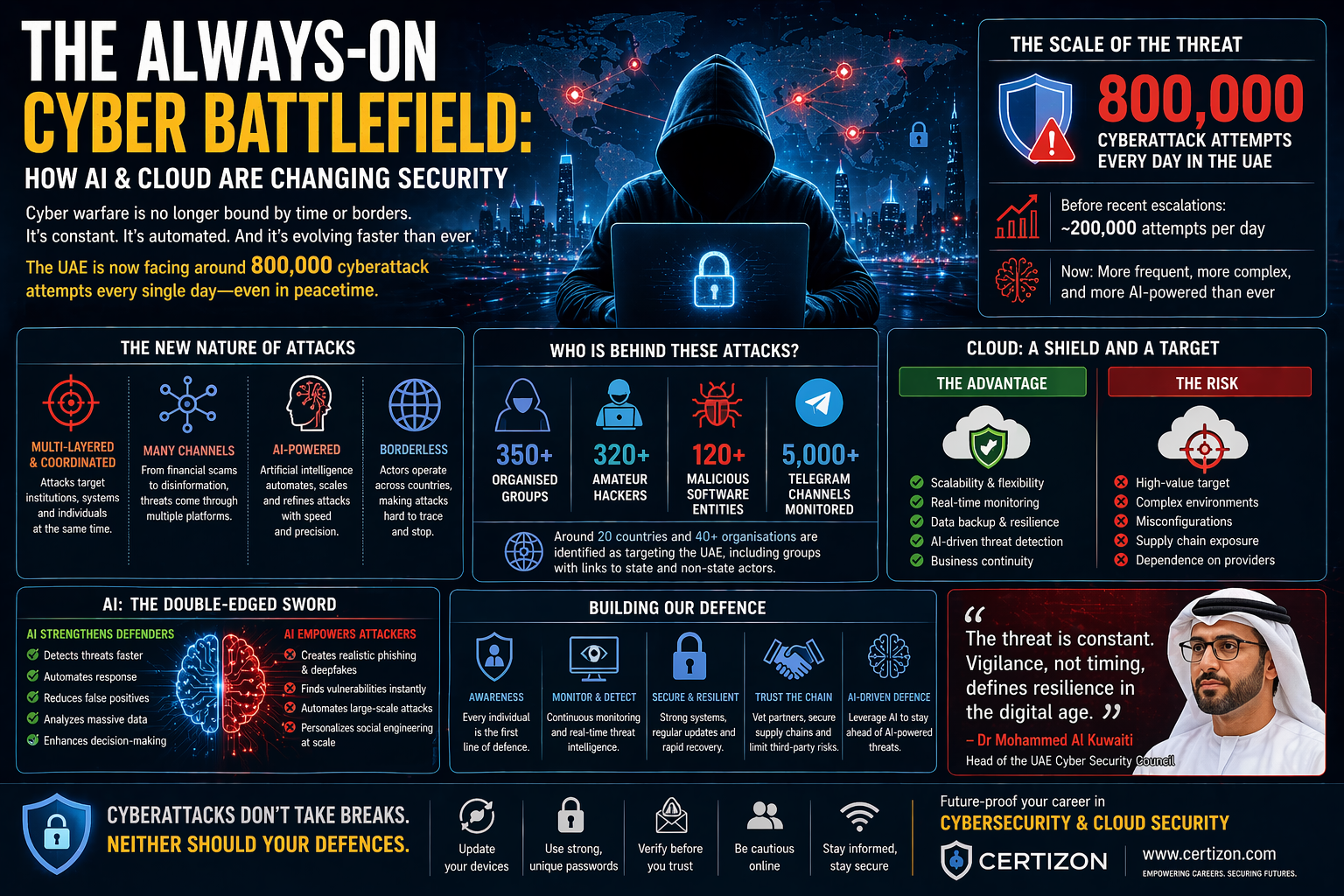
Recent revelations from Dr Mohammed Al Kuwaiti highlight just how intense this new digital battlefield has become. The UAE Cyber Security Council reports that the UAE is now facing around 800,000 cyberattack attempts every single day.
This isn’t happening during wartime alone. It’s happening continuously—even during periods of relative calm.
That number alone tells a powerful story:
Cyber warfare is no longer event-driven. It is persistent, automated, and always active.
⚡ The Shift: From Isolated Attacks to Continuous Warfare
Not long ago, cyberattacks were mostly isolated incidents—targeting a system, exploiting a vulnerability, and ending there. Today, that model has completely changed.
Modern cyber threats are:
- Coordinated across multiple systems
- Simultaneously targeting institutions and individuals
- Operating across borders without limitations
What makes this shift even more dangerous is the rise of artificial intelligence. AI has transformed cyberattacks into highly efficient operations that can adapt, learn, and scale instantly.
Before recent geopolitical escalations, the UAE saw around 200,000 attacks daily. That number has now surged dramatically—showing how quickly the threat landscape is evolving.
🤖 AI: The Engine Behind Modern Cyber Attacks
Artificial intelligence is redefining how cyber warfare operates.
It enables attackers to:
- Automate attacks at massive scale
- Refine phishing and scam techniques
- Target victims with precision
- Launch multi-layered attacks across platforms
This evolution has made cyber threats more complex than ever. Attacks are no longer just about breaking into systems—they are about manipulating behavior, influencing decisions, and exploiting human psychology.
☁️ Cloud Technology in the Crossfire
Cloud platforms like Amazon Web Services, Google Cloud, and Microsoft Azure are at the center of this transformation.
They power:
- Government infrastructure
- Financial systems
- Communication networks
- Enterprise operations
This makes cloud technology both a shield and a target.
🚀 The Advantage
Cloud systems offer resilience through:
- Distributed infrastructure
- Real-time monitoring
- Rapid scalability
- Advanced AI-driven security
They allow organizations to continue operating even under attack.
⚠️ The Risk
At the same time, cloud environments are:
- High-value targets for attackers
- Complex systems with multiple entry points
- Dependent on proper configuration and security practices
A single vulnerability can expose entire ecosystems.
🌐 A Global, Borderless Threat
Cyber warfare today is not limited by geography.
According to UAE authorities:
- Around 20 countries and 40+ organizations are involved in cyber targeting
- Hundreds of organized groups and hackers operate simultaneously
- Thousands of communication channels (including encrypted platforms) are used to coordinate attacks
This highlights a critical reality:
Cyber threats are now global, decentralized, and interconnected.
🏦 Expanding Targets: From Systems to People
One of the most important changes in modern cyberattacks is the shift in focus.
Attackers are no longer targeting only systems—they are targeting:
- Individuals
- Employees
- Consumers
Financial scams, phishing, and social engineering attacks are becoming more advanced, often using AI to appear completely authentic.
As seen in financial sectors globally, attackers are motivated by opportunity—especially when systems involve money, data, or influence.
🧠 The New Defense Mindset
In this evolving threat landscape, traditional security approaches are no longer enough. Organizations must adopt a broader and more adaptive strategy.
Key areas of focus:
- Cyber awareness: Individuals must understand risks and basic security practices
- System resilience: Ability to recover quickly from attacks
- Continuous monitoring: Real-time detection and response
- Supply chain security: Protecting third-party vulnerabilities
- AI-driven defense: Matching attacker capabilities with intelligent systems
As emphasized by UAE leadership, simple practices like updating devices, avoiding suspicious links, and verifying digital interactions remain critical first lines of defense.
🔐 Key Takeaways
- Cyberattacks are now continuous, not occasional
- AI is accelerating both attack and defense capabilities
- Cloud technology is both a backbone and a battlefield
- Threats are increasingly targeting individuals, not just systems
- Awareness and resilience are now more important than prevention alone
💡 Conclusion
We are entering an era where cyber warfare operates silently but constantly—impacting nations, businesses, and individuals alike.
In this new reality:
- There is no “safe time”
- There is no “offline protection”
- There is only preparedness and vigilance
The organizations and professionals who understand this shift—and adapt to it—will define the future of digital security.