
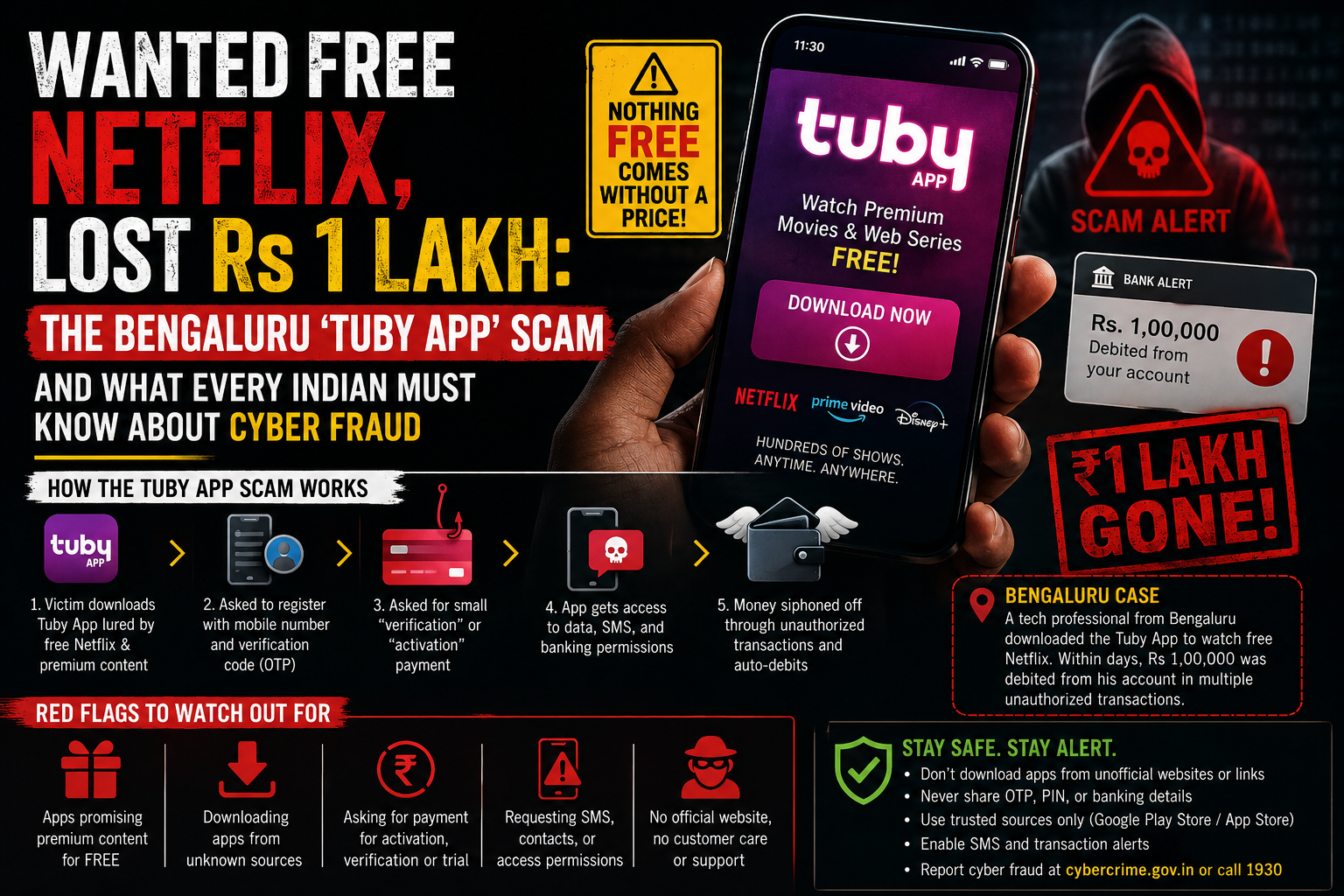
Wanted Free Netflix, Lost Rs 1 Lakh: The Bengaluru 'Tuby App' Scam and What Every Indian Must Know About Cyber Fraud
A 35-year-old store manager in Bengaluru wanted free access to Netflix. Instead, he lost Rs 1 lakh. The method: a mobile application called 'Tuby' that promised free access to popular OTT platforms including Netflix. The reality: a sophisticated cyber fraud operation that harvested the victim's banking credentials and drained his account. The case, reported by Deccan Herald and being investigated by Bengaluru's Ashok Nagar police, is one of thousands of similar incidents that India's cybercrime agencies deal with every year — and one of the most preventable. For IT professionals, cybersecurity educators, and everyday digital users alike, the Tuby app scam is a case study in how modern cyber fraud works, what makes it so effective, and what certified cybersecurity expertise looks like in practice.
What Happened: The Tuby App Scam in Bengaluru
The victim — a 35-year-old store
manager residing in Bengaluru's Ashok Nagar area — was lured by an offer of
free access to paid OTT platforms including Netflix. The offer was delivered
through a mobile application named 'Tuby'. The app was not available through
official channels such as the Google Play Store or Apple App Store — a
significant red flag that was missed or overlooked.
After downloading and installing
the application, the victim was prompted to enter personal and banking
information to 'activate' the free subscription. The fraudsters behind the app
used the harvested information to access the victim's bank account and siphon
off Rs 1 lakh — approximately $1,200 — before the fraud was detected.
The case has been registered
with Bengaluru's Ashok Nagar police, and the Indian Cyber Crime Coordination
Centre (I4C) — the Union Ministry of Home Affairs agency that coordinates
cybercrime response across India — is involved in the broader effort to track
and dismantle such fraud networks.
A 35-year-old store manager lost Rs 1 lakh after downloading a
mobile application called 'Tuby', which promised free access to OTT platforms.
— Deccan Herald, May 20, 2026
How the Tuby App Scam Worked: The Eight-Step Fraud Playbook
The Tuby app scam followed a
well-established fraud pattern that cybersecurity professionals call a 'fake
app social engineering attack.' Understanding each step is the first line of
defence:
|
Stage |
What Happens |
|
Step 1 |
Victim discovers or is sent
a link to the 'Tuby' app promising free access to Netflix and other OTT
platforms |
|
Step 2 |
Victim downloads the app
from a third-party source (outside official app stores) — bypassing Google
Play / Apple App Store safety checks |
|
Step 3 |
App requests extensive
permissions — access to contacts, SMS messages, storage, and potentially
banking apps |
|
Step 4 |
Victim enters personal
information and links payment or banking details to 'activate' the free
subscription |
|
Step 5 |
Fraudsters use harvested
credentials to access the victim's bank accounts or initiate unauthorised
transactions |
|
Step 6 |
Money is withdrawn in
multiple small transactions to avoid triggering automatic bank alerts |
|
Step 7 |
Victim discovers the loss —
often only when checking their bank statement |
|
Step 8 |
Victim files a complaint
with Bengaluru Cyber Crime police or via the I4C cybercrime portal
(cybercrime.gov.in) |
Each step in this sequence is a
deliberate design choice by the fraudsters. The promise of free content
exploits the human desire for value. The third-party download bypasses the
security infrastructure of official app stores. The excessive permission requests
are normalised by the app's framing. And the delayed discovery gives fraudsters
time to transfer funds beyond easy recovery.
Why This Scam Works: The Psychology of Cyber Fraud
The Tuby app scam is not
primarily a technical attack — it is a psychological one. Understanding why it
works on otherwise cautious, intelligent people is essential for building
effective defences.
The Scarcity and Value Trigger
Netflix, Amazon Prime Video, and
JioCinema subscriptions cost between Rs 149 and Rs 649 per month in India. For
many households, OTT subscriptions represent a meaningful monthly expense. An
offer of free access to multiple platforms triggers a powerful psychological
response: the desire to save money combined with the fear of missing out on a
valuable deal. Fraudsters design these offers to appeal to rational
cost-consciousness, making victims feel smart for finding a 'hack' rather than
cautious about a potential fraud.
The Familiarity Deception
The app name 'Tuby' is designed
to sound vaguely familiar — echoing 'YouTube' and 'tube' as generic media
streaming terms. The app's interface likely mimicked legitimate streaming
platform designs, using familiar colour schemes, iconography, and language.
Familiarity reduces vigilance. When something looks and feels like what we
expect, our critical evaluation drops.
The Authority and Legitimacy Illusion
Fake apps like Tuby frequently
use stolen brand assets — Netflix logos, subscription tier descriptions, and
membership language — to create the impression of official affiliation. When
combined with a professional-looking interface, this creates an authority
illusion that bypasses the victim's natural scepticism.
The One-Time Effort Justification
Entering banking details is
reframed by the scam as a one-time verification step — 'just to confirm you are
a real person' or 'to process your free subscription.' This framing normalises
the information-sharing by making it feel proportionate to the reward and
temporary in nature.
Red Flags: How to Identify a Fake App or OTT Scam
Every cyber fraud leaves traces
— warning signs that, in hindsight, clearly indicate danger. Training yourself
to recognise these red flags before interacting with suspicious offers is the
most effective protection available:
|
Red Flag |
How It
Appeared in the Tuby App Scam |
Risk Level |
|
Too-good-to-be-true
offer |
Free access to paid
streaming platforms (Netflix, Amazon Prime, Hotstar) that cost Rs
149-499/month |
HIGH |
|
Third-party
app download |
App not available on Google
Play Store or Apple App Store — requires enabling 'unknown sources' |
CRITICAL |
|
Excessive
permissions |
App requests access to SMS,
contacts, banking apps, or call logs — unnecessary for a media app |
CRITICAL |
|
No official
branding |
App name ('Tuby') does not
match any known OTT platform; no verifiable company behind it |
HIGH |
|
Urgency or
time limit |
'Limited offer — activate
now' messaging designed to prevent careful evaluation |
MEDIUM |
|
Payment to
access free content |
Being asked to enter banking
details or make a small payment to 'verify' for a free service |
CRITICAL |
|
No contact
information |
No verifiable customer
support, physical address, or registered company details |
HIGH |
|
Social
media or WhatsApp promotion |
Offer spread via WhatsApp
forwards or social media rather than through official platform channels |
MEDIUM |
The Scale of the Problem: Cybercrime in India in 2026
The Bengaluru store manager's
experience is not an isolated incident. It is one data point in a rapidly
escalating national crisis. India has become one of the world's largest targets
for cybercrime, driven by a combination of factors:
•
Rapid smartphone penetration — over 750 million
smartphone users, many newly connected and with limited digital literacy
•
Growing digital payments adoption — UPI, mobile
banking, and digital wallets have made financial transactions faster and
simpler — and created new attack surfaces for fraudsters
•
OTT subscription culture — the growth of streaming
platforms has created widespread familiarity with subscription models, making
fake subscription offers more plausible
•
Work-from-home and digital-first economy — more time
spent online increases exposure to fraudulent apps, phishing links, and social
engineering attacks
•
Sophisticated fraud networks — cybercrime operations
targeting India are increasingly organised, technically sophisticated, and
operating from locations with limited law enforcement reach
I4C — the Indian Cyber Crime
Coordination Centre — operates the national cybercrime reporting portal at
cybercrime.gov.in and coordinates between state police forces, banking
institutions, and central agencies to investigate and respond to cybercrime. The
1930 helpline is the national cybercrime helpline that victims can call
immediately after a financial fraud to initiate response and attempt to block
fraudulent transactions before funds are transferred out of reach.
What To Do If You Have Been Scammed: Immediate Steps
If you or someone you know has
fallen victim to a fake app scam like the Tuby fraud, time is critical. Here is
what to do immediately:
•
Call 1930 immediately — this is India's national
cybercrime helpline. Report the fraud as quickly as possible; early reporting
significantly increases the chance of blocking the transaction
•
File a complaint at cybercrime.gov.in — the I4C online
portal accepts cybercrime complaints 24/7 and routes them to the appropriate
state police agency
•
Contact your bank immediately — call your bank's
24-hour fraud helpline, report the unauthorised transactions, and request that
your account be frozen pending investigation
•
Uninstall the fraudulent app — remove the app
immediately and revoke any permissions it was granted. Consider performing a
factory reset if you are concerned that the app may have installed additional
malware
•
Change all passwords — change your banking passwords,
UPI PINs, email passwords, and any other credentials that may have been
compromised
•
File a police complaint — visit your local police
station or the Cyber Crime police station in your city to file a formal First
Information Report (FIR)
•
Preserve all evidence — take screenshots of the app,
the messages or links that directed you to it, and any transaction records
before uninstalling
For IT Professionals: The Certifications That Build Cyber Fraud Defence
Skills
The Tuby app scam represents a
class of threat that certified cybersecurity professionals are specifically
trained to understand, prevent, and respond to. For IT professionals in India
who want to build careers in cybersecurity — and contribute to India's growing
need for digital fraud defence expertise — here are the most relevant
certification paths:
|
Certification |
Why It
Matters for Cases Like the Tuby App Scam |
|
CompTIA
Security+ |
The foundational global
cybersecurity certification. Covers social engineering, phishing, malware,
mobile security, and threat identification — all directly relevant to the
Tuby app attack vector. |
|
Certified
Ethical Hacker (CEH) |
Teaches offensive security
thinking. CEH holders understand how fraudsters design fake apps, harvest
credentials, and conduct social engineering attacks — essential for building
effective defences. |
|
CompTIA
CySA+ |
Cybersecurity analyst
credential covering threat intelligence, behavioural analysis, and incident
response. Directly applicable to investigating and responding to mobile fraud
cases. |
|
Certified
Information Security Manager (CISM) |
Management-level credential
covering incident response, risk management, and information security policy
— relevant for IT managers responsible for cybercrime awareness programmes in
organisations. |
|
ISO/IEC
27001 Lead Implementer |
International information
security management standard. Covers the policies and controls that
organisations implement to protect employees from social engineering and
fraudulent app attacks. |
|
CCSP
(Certified Cloud Security Professional) |
Covers mobile application
security, app store vetting, and cloud-delivered security controls — directly
relevant to the threat posed by rogue mobile applications like Tuby. |
|
Digital
Forensics & Incident Response (DFIR) |
Covers how cybercrime
investigators trace fraudulent transactions, identify attackers, and recover
evidence — the skills used by I4C and Bengaluru Cyber Crime police to
investigate cases like this one. |
The Growing Demand for Cybersecurity Professionals in India
India faces a severe and
widening cybersecurity talent shortage. According to industry estimates, India
needs over 1 million cybersecurity professionals by 2027 — but currently has
fewer than 250,000. This gap creates extraordinary career opportunities for IT
professionals who invest in cybersecurity certifications.
The demand is being driven from
multiple directions simultaneously:
•
Government — I4C, state Cyber Crime units, CERT-In, and
the National Critical Information Infrastructure Protection Centre (NCIIPC) all
require certified cybersecurity professionals
•
Banking and financial services — RBI guidelines mandate
that banks maintain robust cybersecurity infrastructure and incident response
capabilities
•
IT services — TCS, Infosys, Wipro, HCL, and every major
Indian IT services firm has growing cybersecurity practices serving global
enterprise clients
•
Startups and fintech — India's startup ecosystem, with
its reliance on digital payments, mobile apps, and cloud infrastructure,
requires cybersecurity expertise at every growth stage
•
Corporate India — every organisation that processes
employee, customer, or financial data has a growing legal and reputational
obligation to secure it
For IT professionals in
Bengaluru — India's technology capital and the city where the Tuby app scam
occurred — cybersecurity roles offer among the highest salary premiums in the
technology sector. Certified professionals command 30 to 50% salary premiums
over non-certified peers in equivalent roles.
Frequently Asked Questions
Q1: What was the Tuby app and how did it scam users?
Tuby was a fraudulent mobile
application that promised free access to paid OTT platforms including Netflix.
It was distributed through third-party channels rather than official app
stores. After installation, it harvested victims' banking credentials and
personal information, which fraudsters used to steal money from their bank
accounts. A 35-year-old store manager in Bengaluru lost Rs 1 lakh to this scam.
Q2: How can I tell if a free OTT or subscription offer is a scam?
Key warning signs include: the
app is not available on Google Play Store or Apple App Store; the offer
promises free access to services that normally cost money; the app requests
excessive permissions (SMS, contacts, banking access); you are asked to enter
banking or payment details to access free content; there is no verifiable
company or contact information behind the offer; and the offer is promoted
through WhatsApp forwards or social media rather than official platform
channels.
Q3: What should I do immediately if I have been scammed?
Call 1930 (India's national
cybercrime helpline) immediately, report the fraud at cybercrime.gov.in,
contact your bank's fraud helpline to freeze your account, uninstall the
fraudulent app, change all passwords and PINs, file a police complaint, and
preserve all evidence including screenshots of the app and messages.
Q4: What is I4C and how does it help cybercrime victims?
The Indian Cyber Crime
Coordination Centre (I4C) is a central government agency under the Union
Ministry of Home Affairs. It coordinates cybercrime response across India,
operates the national cybercrime reporting portal at cybercrime.gov.in, and
runs the 1930 helpline. It works with state police forces, banks, and other
agencies to investigate cybercrime and assist victims.
Q5: What cybersecurity certifications are most valuable for combating fraud
like the Tuby scam?
The most relevant certifications
include CompTIA Security+ (foundational security covering social engineering
and mobile threats), Certified Ethical Hacker (CEH), CompTIA CySA+ (threat
detection and incident response), CISM (security management), CCSP (cloud and
mobile application security), and Digital Forensics & Incident Response
(DFIR) credentials. Certizon offers globally recognised programmes across all
of these tracks.
Build Digital Safety — for Yourself, Your Organisation, and Your Community
The Bengaluru store manager who
lost Rs 1 lakh to the Tuby app scam is not unusual. Cyber fraud victims include
educated professionals, experienced business people, and technology-aware
individuals across every income level and city in India. The fraud works not
because victims are careless but because it is carefully designed to bypass our
natural defences.
The most powerful counter is
knowledge — specifically, the kind of structured, certified knowledge that
cybersecurity professionals develop through rigorous training. For IT
professionals who want to build careers in cybersecurity and contribute to
India's digital safety, Certizon's certification programmes provide the
foundation.
Visit certizon.com to explore our full cybersecurity
certification catalogue, access free trial courses, and speak with a career
advisor today.
Free Netflix costs nothing. Certified cybersecurity knowledge is worth everything.