
War, AI & Cloud: The Rapid Evolution of Cyber Attacks
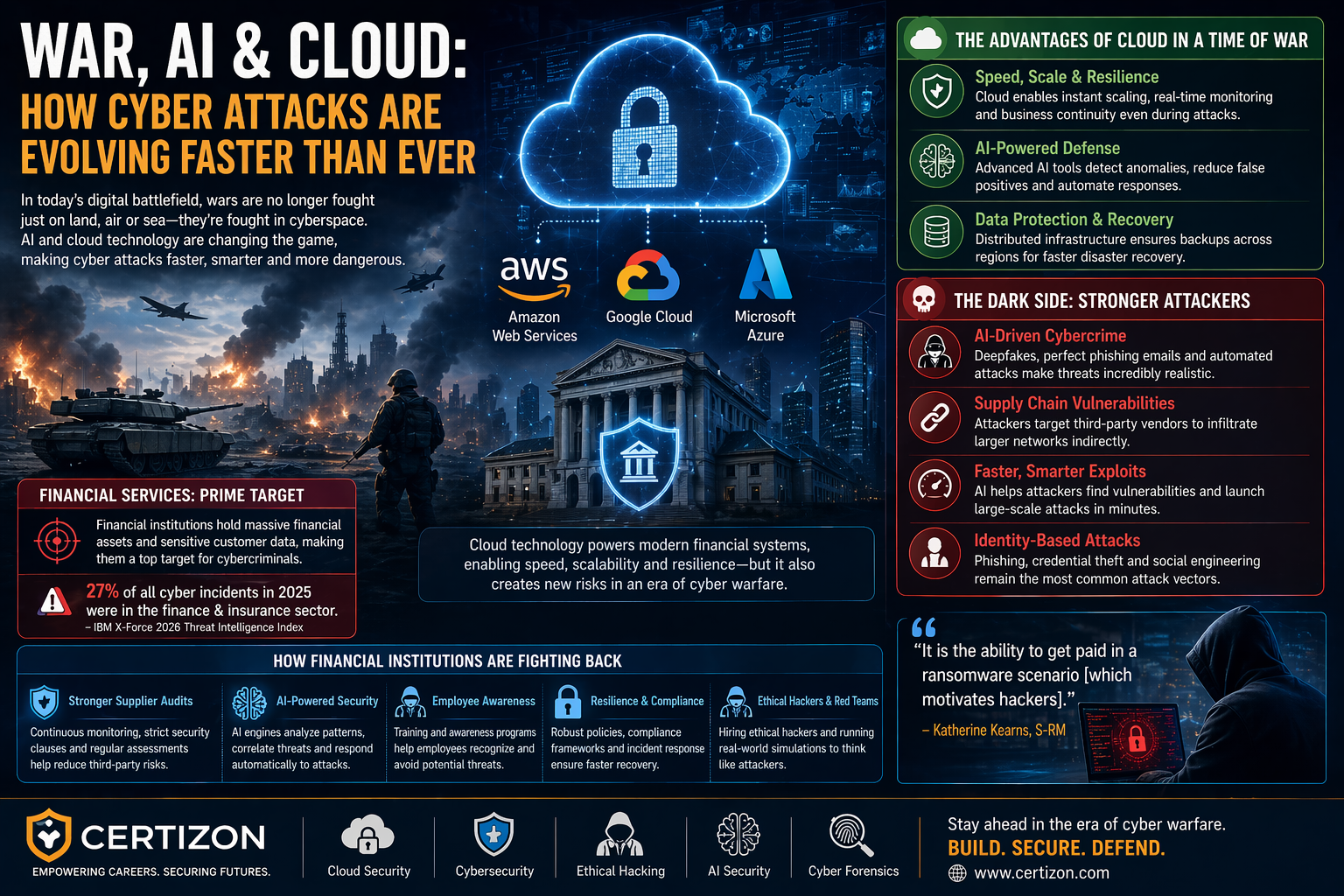
The nature of conflict is changing faster than ever. Wars are no longer limited to physical battlefields—they are increasingly fought in cyberspace, where data, systems, and infrastructure have become prime targets. As geopolitical tensions rise, cyber warfare is accelerating, driven by advancements in artificial intelligence and cloud technology.
What makes this shift more dangerous is not just the increase in attacks, but the speed at which they happen. The time between identifying a vulnerability and exploiting it has reduced drastically. What once took weeks can now happen in hours—or even minutes.
⚡ The Acceleration of Cyber Threats
Modern attackers are no longer working manually. With AI and automation, cybercrime has evolved into a highly efficient system.
- Vulnerabilities are detected faster using AI tools
- Attacks are automated and launched at scale
- Social engineering has become more realistic (deepfakes, AI emails)
This shift has created a scenario where organizations are constantly playing catch-up.
🏦 Why Financial Institutions Are Under Pressure
Financial institutions sit at the center of this evolving threat landscape. They are not just businesses—they are the backbone of global economies.
Their attractiveness as targets comes from:
- Massive financial reserves
- Sensitive customer data
- High pressure to recover quickly from attacks
In fact, the finance and insurance sector accounts for a significant portion of global cyber incidents. The motivation behind many of these attacks remains simple—financial gain.
As highlighted by cybersecurity experts, attackers are often driven by the ability to profit from ransomware attacks.
☁️ Cloud Technology: Strength & Vulnerability
Cloud platforms such as Amazon Web Services, Google Cloud, and Microsoft Azure have become essential to modern infrastructure.
They power everything from banking systems to national operations. This makes them both a powerful defense mechanism and a critical attack surface.
🚀 Where Cloud Helps
Cloud technology enables organizations to stay resilient even in crisis situations:
- Scalability: Systems can handle sudden spikes during attacks
- Real-time monitoring: Threats can be detected instantly
- Data backup & recovery: Distributed systems ensure continuity
- AI-powered security: Faster and smarter threat detection
These capabilities are crucial in a world where downtime can cost millions.
⚠️ Where Cloud Creates New Risks
At the same time, cloud environments introduce new challenges:
- High-value targets: Large-scale systems attract nation-state attackers
- Shared responsibility risks: Misconfigurations can expose data
- Dependency on providers: Reliance on big tech raises control concerns
- Complex environments: More integrations = more entry points
This dual nature makes cloud both an asset and a vulnerability.
🤖 AI: The Double-Edged Sword
Artificial intelligence is transforming cybersecurity—but on both sides.
On one hand, it helps organizations:
- Detect threats early
- Automate responses
- Reduce false positives
On the other hand, attackers are using AI to:
- Create highly convincing phishing attacks
- Generate deepfake voices and videos
- Identify weak points in systems instantly
As one expert described, modern phishing attempts can look “almost perfect,” making them extremely difficult to identify.
🔗 The Rise of Supply Chain Attacks
One of the most concerning trends is the shift towards indirect attacks.
Instead of targeting large organizations directly, attackers:
- Exploit smaller vendors
- Target third-party integrations
- Use weak links to enter stronger systems
This “backdoor” strategy is becoming increasingly common and effective.
🧠 How Organizations Are Responding
In response to this rapidly evolving threat landscape, companies—especially in finance—are rethinking cybersecurity.
Some of the key actions include:
- Stronger vendor security checks to reduce third-party risks
- AI-powered defense systems for real-time threat detection
- Employee awareness training to reduce human errors
- Hiring ethical hackers to simulate real-world attacks
- Focus on resilience, not just prevention
The goal is no longer just to stop attacks—but to survive and recover quickly.
🌐 The Bigger Picture
Cyber warfare is now a core part of global conflict. It is impacting economies, disrupting industries, and redefining security strategies.
Cloud technology sits at the center of this transformation—powering systems, enabling defense, and at the same time, becoming a primary target.
🔐 Key Takeaways
- Cyber attacks are becoming faster, smarter, and AI-driven
- Financial institutions remain top targets
- Cloud is both a security enabler and a risk factor
- Human error continues to be a major vulnerability
- Organizations must shift from protection → resilience mindset
💡 Conclusion
We are no longer preparing for cyber warfare—it is already happening.
In this new digital battlefield:
- Speed defines success
- Data defines value
- Cloud defines control
The organizations and professionals who adapt quickly will lead the future.