
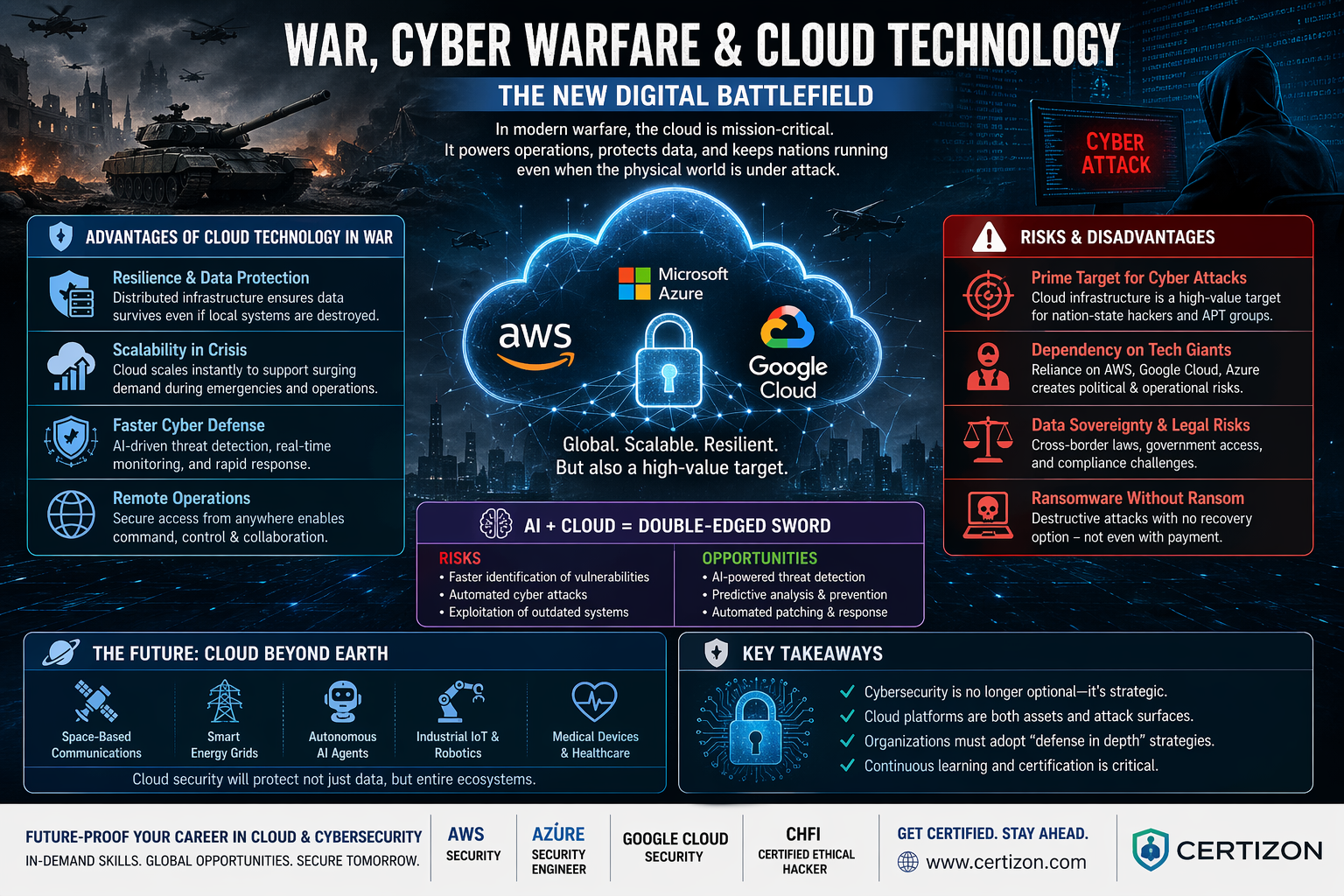
War, Cyber Warfare & Cloud Computing: The New Digital Battlefield
In today’s world, wars are no longer fought only with missiles, tanks, or troops. They are increasingly fought in the invisible realm of cyberspace—where data, infrastructure, and cloud platforms have become strategic assets.
Recent insights shared by Richard Horne, head of the National Cyber Security Centre (NCSC), highlight a critical shift:
Cyber attacks are now an integral part of modern conflict.
With nation-state cyber attacks rising sharply, and global tensions escalating, cloud technologies like Amazon Web Services, Google Cloud, and Microsoft Azure are no longer just IT infrastructure—they are now part of national defense systems.
☁️ The Strategic Role of Cloud Technology in Modern Warfare
Cloud computing has become the backbone of digital economies, governments, and military operations.
Why Cloud Matters in War:
- Real-time intelligence sharing
- Military communication systems
- Data storage for national infrastructure
- AI-powered decision-making systems
During conflicts like the Russia-Ukraine War, cloud platforms played a critical role in:
- Protecting government data from physical destruction
- Ensuring continuity of services
- Enabling global collaboration
🚀 Advantages of Cloud Technology During War
1. Resilience & Data Protection
Cloud systems are distributed globally, making it difficult for attackers to completely destroy data.
- Even if local data centers are attacked, backups exist elsewhere
- Disaster recovery becomes faster and more reliable
2. Scalability in Crisis
During war, demand spikes suddenly:
- Emergency services
- Military operations
- Cyber defense systems
Cloud platforms scale instantly to meet demand.
3. Faster Cyber Defense
Cloud providers invest billions in cybersecurity:
- AI-based threat detection
- Real-time monitoring
- Automated response systems
This gives nations a defensive advantage against cyber attacks.
4. Remote Operations
Governments and organizations can operate from anywhere:
- Remote command centers
- Decentralized decision-making
- Secure communication networks
⚠️ Disadvantages & Risks of Cloud in War
1. Prime Target for Cyber Attacks
Cloud infrastructure becomes a high-value target for:
- Nation-state hackers
- Advanced Persistent Threats (APTs)
- Hybrid warfare strategies
As reported, groups linked to Russia and China are using battlefield-tested cyber techniques globally.
2. Dependency on Private Tech Giants
Countries relying heavily on companies like Amazon, Google, and Microsoft face risks:
- Political influence
- Service restrictions during conflict
- Data sovereignty concerns
3. Data Sovereignty & Legal Risks
Where your data is stored matters:
- Cross-border data laws
- Government access to data
- Compliance challenges
4. “Ransomware Without Ransom”
A new trend in cyber warfare:
- Attacks designed to destroy or disrupt
- No recovery option—even with payment
This makes cloud resilience more critical than ever.
🤖 AI + Cloud = Double-Edged Sword
Advanced AI systems like Mythos AI model are exposing vulnerabilities in software at scale.
Risks:
- Faster identification of system weaknesses
- Automated cyber attacks
- Exploitation of outdated infrastructure
Opportunities:
- AI-powered cyber defense
- Predictive threat detection
- Automated patching systems
🛰️ The Future: Cloud Beyond Earth
Cybersecurity is expanding beyond traditional IT systems:
- Space-based communication systems
- Autonomous AI agents
- Smart energy grids
- Medical devices connected to cloud
Cloud security will soon protect:
➡️ Cities
➡️ Power plants
➡️ Satellites
➡️ Even human-integrated technologies
🔐 Key Takeaways for Businesses & Professionals
- Cybersecurity is no longer optional—it’s strategic
- Cloud platforms are both assets and attack surfaces
- Organizations must adopt “defense in depth” strategies
- Continuous learning and certification in cloud & cybersecurity is critical
🎯 Why This Matters for Your Career
As cyber warfare evolves, professionals skilled in:
- Cloud Security
- Ethical Hacking
- Digital Forensics
- AI Security
…will be in massive demand.
Certifications like:
- AWS Security
- Azure Security Engineer
- Google Cloud Security
- CHFI (Computer Hacking Forensic Investigator)
…are becoming essential to stay relevant in this rapidly changing landscape.
💡Conclusion
We are entering an era where:
“The next battlefield is not just land, air, or sea—but the cloud.”
The organizations and nations that invest in secure, resilient, and intelligent cloud systems will define the future of global power.