
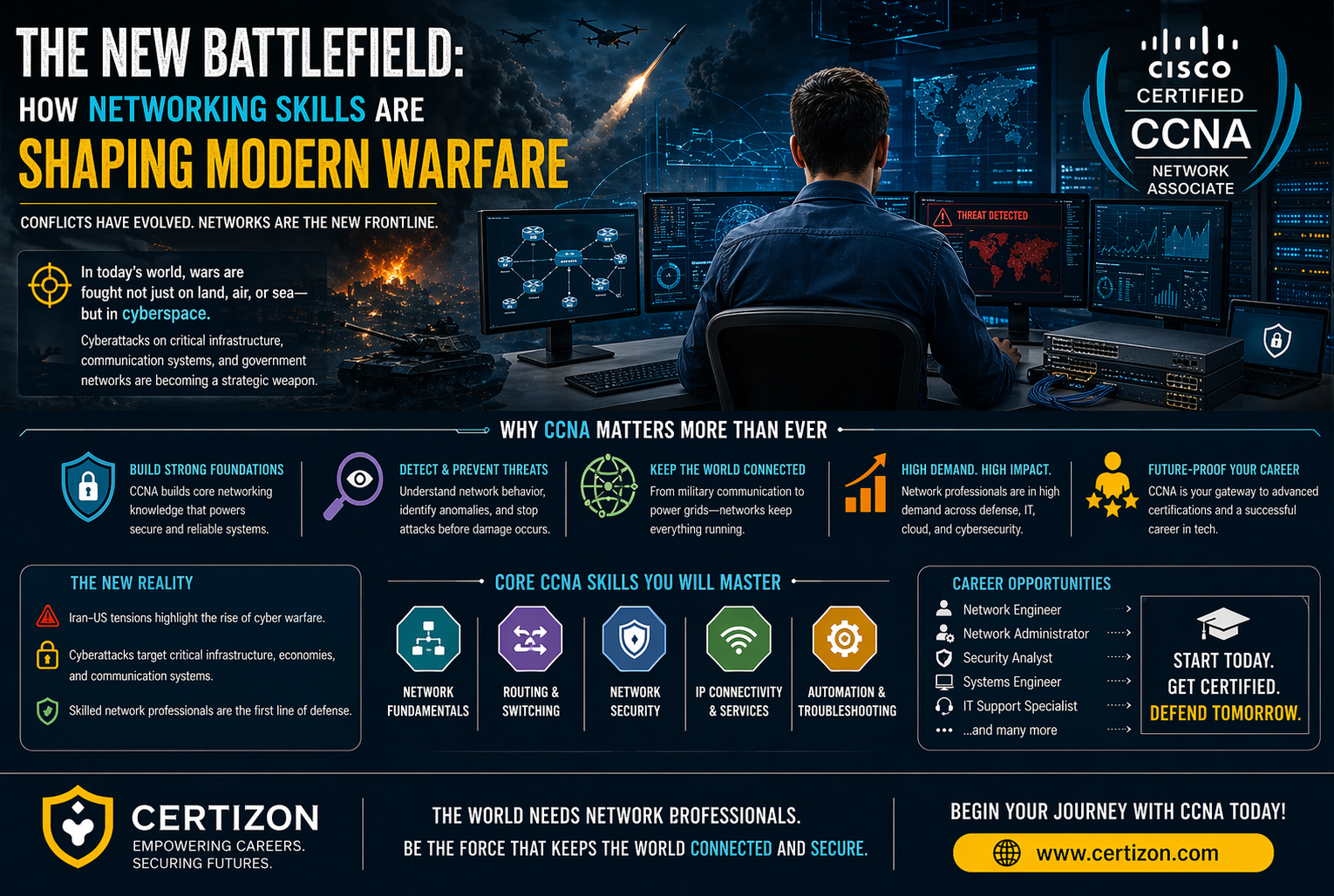
When Wars Go Digital, Networks Decide the Outcome
The world is changing—and so is warfare.
Conflicts today are no longer fought only with missiles and military power. They are increasingly fought through networks, data, and digital infrastructure. The recent tensions between Iran and the United States clearly show that cyber warfare is now a core part of modern conflict.
Behind every cyberattack, disruption, or defense—there is one common foundation: networking.
This is where certifications like the Cisco Certified Network Associate become critically important.
⚔️ War Has Entered the Digital Layer
Recent developments show that cyber operations are now deeply integrated into geopolitical conflicts.
- Cyberattacks are targeting critical infrastructure like energy and water systems
- Iran-linked hackers have escalated attacks on U.S. networks and services
- Cyber operations are being used alongside military actions to disrupt communication and control systems
Even more concerning, cyber warfare is no longer occasional—it’s continuous and strategic.
🌐 Networks: The Real Battlefield
Every system targeted in modern cyber warfare relies on networks:
- Power grids
- Banking systems
- Military communication
- Cloud infrastructure
- Internet connectivity
Even undersea cables—carrying over 95% of global data—are now considered vulnerable targets during conflicts
➡️ If networks fail, everything fails.
🧠 Where CCNA Fits In
The Cisco CCNA certification is designed to build a strong foundation in networking—the very backbone of modern systems.
It teaches you how to:
- Design and manage networks
- Secure network infrastructure
- Troubleshoot connectivity issues
- Understand routing, switching, and protocols
In a world facing cyber threats, these skills are no longer optional—they are essential.
🔄 From Attack to Defense: The Role of Network Professionals
In the context of modern conflict, network professionals are the first line of defense.
They help:
- Detect unusual traffic (potential cyberattacks)
- Secure routers, switches, and endpoints
- Prevent unauthorized access
- Maintain system availability during attacks
Without skilled networking professionals, even the best cybersecurity tools cannot function effectively.
🤖 AI + Cyber Warfare = More Pressure on Networks
Modern cyberattacks are becoming:
- Faster
- Automated
- Harder to detect
Reports suggest that dozens of cyber groups can mobilize within hours during geopolitical escalation
This puts massive pressure on network systems—and the people managing them.
🚀 Why CCNA Is More Relevant Than Ever
CCNA is not just a beginner certification anymore—it’s a strategic career move in today’s world.
It helps you:
- Understand real-world network vulnerabilities
- Build secure and scalable systems
- Work in roles like Network Engineer, Security Analyst, IT Support
- Stay relevant in a cyber-driven job market
It prepares you for:
- Cybersecurity roles
- Cloud networking
- Infrastructure management
- Advanced certifications (like CCNP, security tracks)
🌐 The Bigger Picture
The Iran–US conflict shows us one critical reality:
Modern wars are fought across both physical and digital fronts.
Cyber operations are now:
- Disrupting infrastructure
- Targeting civilians indirectly
- Influencing global systems
And at the core of all of this lies networking.
🧩 Conclusion
If there’s one lesson from today’s global conflicts, it’s this—
everything runs on networks, and everything can be disrupted through them.
That’s why skills in networking are no longer just technical—they are strategic.
Certifications like CCNA don’t just help you get a job.
They prepare you to understand and protect the systems the world depends on.
In a world where cyber threats are growing every day,
those who understand networks will always stay ahead.